 Quran
Quran
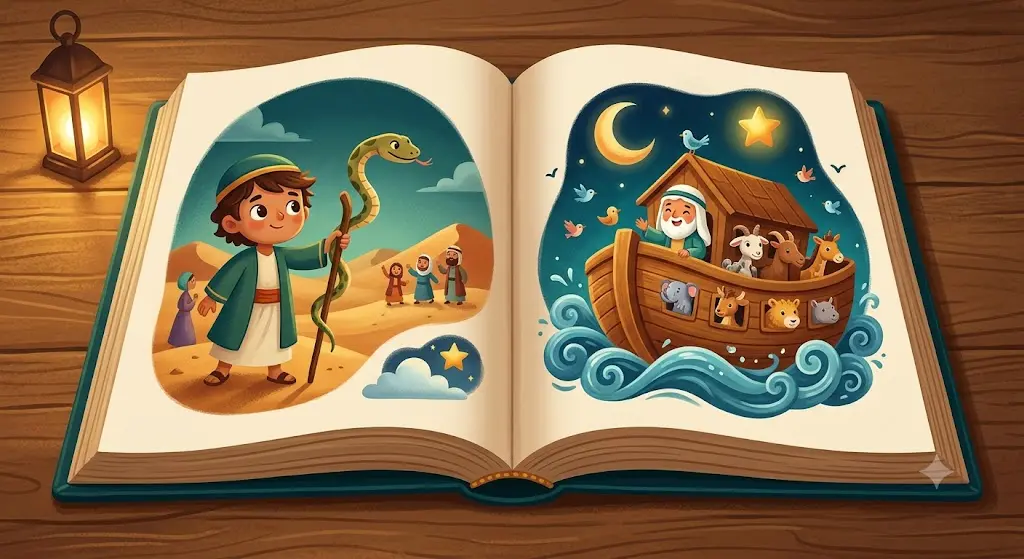
Every child loves a good story. And the Quran holds some of the most powerful, vivid, and emotionally rich stories ever told — stories of prophets who faced impossible odds, of animals who carried divine messages, of young people who chose faith over fear. These aren’t just ancient narratives. They are living lessons that shape character, build faith, and give children real answers to real emotions.
This guide walks you through the most important Quran stories for kids, why they matter developmentally, and how to bring each lesson to life at home.
The Quran mentions 25 prophets by name, and their stories cover a wide range of human experiences — patience, courage, repentance, gratitude, and trust in Allah. The stories below are the ones children connect with most deeply and the ones that carry the clearest lessons for daily life.
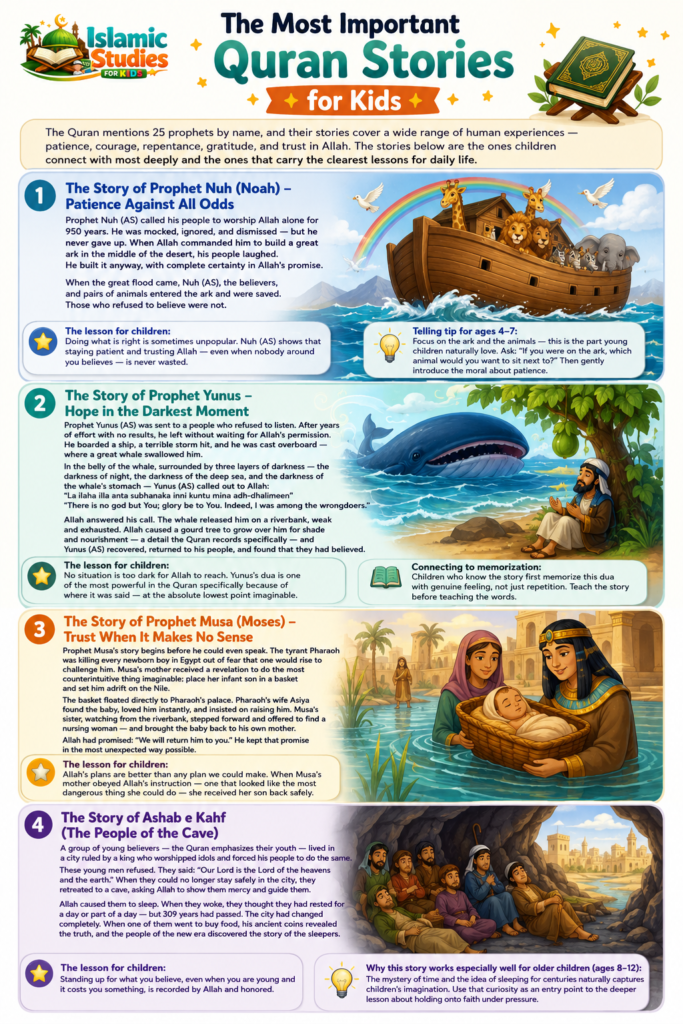
The Story of Prophet Nuh (Noah) — Patience Against All Odds
Prophet Nuh (AS) called his people to worship Allah alone for 950 years. He was mocked, ignored, and dismissed — but he never gave up. When Allah commanded him to build a great ark in the middle of the desert, his people laughed. He built it anyway, with complete certainty in Allah’s promise.
When the great flood came, Nuh (AS), the believers, and pairs of animals entered the ark and were saved. Those who refused to believe were not.
The lesson for children: Doing what is right is sometimes unpopular. Nuh (AS) shows that staying patient and trusting Allah — even when nobody around you believes — is never wasted. This story is especially useful for children who feel different from their peers because of their faith.
Telling tip for ages 4–7: Focus on the ark and the animals — this is the part young children naturally love. Ask: “If you were on the ark, which animal would you want to sit next to?” Then gently introduce the moral about patience.
The Story of Prophet Yunus — Hope in the Darkest Moment
Prophet Yunus (AS) was sent to a people who refused to listen. After years of effort with no results, he left without waiting for Allah’s permission. He boarded a ship, a terrible storm hit, and he was cast overboard — where a great whale swallowed him.
In the belly of the whale, surrounded by three layers of darkness — the darkness of night, the darkness of the deep sea, and the darkness of the whale’s stomach — Yunus (AS) called out to Allah:
“La ilaha illa anta subhanaka inni kuntu mina adh-dhalimeen” “There is no god but You; glory be to You. Indeed, I was among the wrongdoers.”
Allah answered his call. The whale released him on a riverbank, weak and exhausted. Allah caused a gourd tree to grow over him for shade and nourishment — a detail the Quran records specifically — and Yunus (AS) recovered, returned to his people, and found that they had believed.
The lesson for children: No situation is too dark for Allah to reach. Yunus’s dua is one of the most powerful in the Quran specifically because of where it was said — at the absolute lowest point imaginable. Children who memorize this dua understand that they can say it in their own difficult moments.
Connecting to memorization: Children who know the story first memorize this dua with genuine feeling, not just repetition. Teach the story before teaching the words.
The Story of Prophet Musa (Moses) — Trust When It Makes No Sense
Prophet Musa’s story begins before he could even speak. The tyrant Pharaoh was killing every newborn boy in Egypt out of fear that one would rise to challenge him. Musa’s mother received a revelation to do the most counterintuitive thing imaginable: place her infant son in a basket and set him adrift on the Nile.
The basket floated directly to Pharaoh’s palace. Pharaoh’s wife Asiya found the baby, loved him instantly, and insisted on raising him. Musa’s sister, watching from the riverbank, stepped forward and offered to find a nursing woman — and brought the baby back to his own mother.
Allah had promised: “We will return him to you.” He kept that promise in the most unexpected way possible.
The lesson for children: Allah’s plans are better than any plan we could make. When Musa’s mother obeyed Allah’s instruction — one that looked like the most dangerous thing she could do — she received her son back safely. This teaches children that trusting Allah, even when it is difficult to understand, produces results that human reasoning alone cannot reach.
The Story of Ashab e Kahf (The People of the Cave)
The Ashab e Kahf story for kids is one of the most remarkable in the Quran. A group of young believers — the Quran emphasizes their youth — lived in a city ruled by a king who worshipped idols and forced his people to do the same.
These young men refused. They said: “Our Lord is the Lord of the heavens and the earth.” When they could no longer stay safely in the city, they retreated to a cave, asking Allah to show them mercy and guide them.
Allah caused them to sleep. When they woke, they thought they had rested for a day or part of a day — but 309 years had passed. The city had changed completely. When one of them went to buy food, his ancient coins revealed the truth, and the people of the new era discovered the story of the sleepers.
The lesson for children: Standing up for what you believe, even when you are young and it costs you something, is recorded by Allah and honored. The Quran mentions their youth specifically — “they were young men who believed in their Lord” — which tells children that age is not a barrier to faith or courage.
Why this story works especially well for older children (ages 8–12): The mystery of time and the idea of sleeping for centuries naturally captures children’s imagination. Use that curiosity as an entry point to the deeper lesson about holding onto faith under pressure.
Animal Stories from the Quran for Kids
The Quran includes animals in several narratives — not as background details, but as central participants through whom Allah demonstrates His power and wisdom.
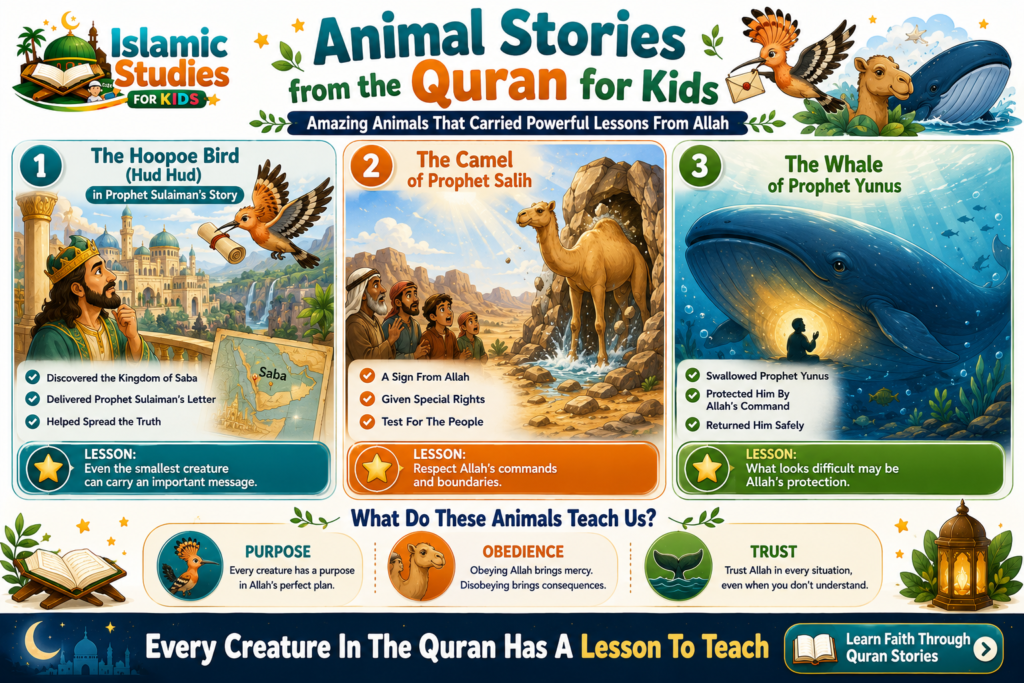
The Hoopoe Bird (Hud Hud) in Prophet Sulaiman’s Story
Prophet Sulaiman (AS) was a king and prophet who could understand the language of birds and animals. One day he noticed that the hoopoe bird (hud hud) was absent. He announced that the bird would need a very good reason for being missing, or face punishment.
The hoopoe returned with remarkable news: he had discovered a great kingdom in Saba (present-day Yemen) ruled by a queen — a woman named Bilqis — whose people worshipped the sun instead of Allah. Sulaiman (AS) sent a letter with the bird to invite her to Islam.
The lesson: Even the smallest creature can carry an important message. No role is too small in the service of truth.
The Camel of Prophet Salih
Prophet Salih (AS) was sent to the people of Thamud, who demanded a miracle as proof of his prophethood. A she-camel emerged from solid rock — an extraordinary miracle — and Salih (AS) told his people to give her specific days at the water source and to leave her in peace.
They killed her anyway, in defiance of Allah’s command. The punishment that followed was total. This story teaches children that Allah’s boundaries are not suggestions — and that arrogance toward clear signs has consequences.
Read also: Rights of Children in Islam – A Complete Guide for Muslim Parents
Experience a Real Classroom
Curious about how we teach? This video offers a glimpse into a real class, showcasing our interactive approach, qualified teachers, and child-friendly learning experience.
Fun & Engaging Islamic Classes for Kids
Start your child’s journey today with interactive lessons designed to make learning Islam loved and easy.
Get Your Child a Free TrialThe Whale of Prophet Yunus
The whale in Yunus’s story is not a villain — it is a vessel of preservation, commanded by Allah to protect the prophet even as it swallowed him. This is one of the most counterintuitive images in the Quran: something that looks like destruction is actually protection in disguise.
Children respond strongly to this idea because it mirrors their own experiences — situations that feel bad, but which contain something they cannot yet see.
How to Tell Quran Stories by Age Group?
One mistake parents often make is telling the same story the same way at every age. Quran stories have layers. The same narrative that teaches a 5-year-old about patience can teach a 12-year-old about strategic faith and a 15-year-old about the theology of divine decree.
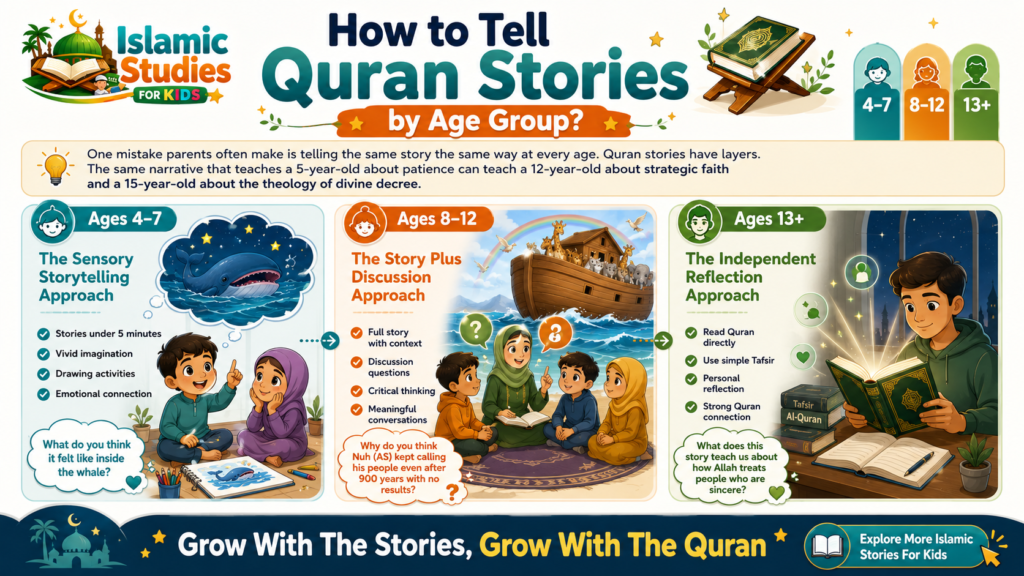
Ages 4–7 — The Sensory Storytelling Approach
Keep stories under five minutes. Use vivid sensory details: “What do you think it felt like inside the belly of the whale — dark, cold, quiet?” Let children draw what they imagined. The goal at this age is emotional familiarity — children should feel they know these prophets as real people, not distant historical figures.
Ages 8–12 — The Story Plus Discussion Approach
Tell the full story with context. Then ask one discussion question: “Why do you think Nuh (AS) kept calling his people even after 900 years with no results?” The question does not need a right answer — the thinking is the learning.
Explore more Islamic stories for kids here.
Ages 13+ — The Independent Reflection Approach
Encourage teenagers to read the Quranic passages directly, supported by a basic tafsir. Then discuss: “What does this story tell us about how Allah treats people who are sincere?” Teens who engage with the primary Quranic text develop a personal relationship with the Quran that Insha’Allah lasts into adulthood.
Quran Bedtime Stories for Kids — Making Nightly Story Time Islamic
Bedtime is one of the most effective learning windows in a child’s day. The mind is calm, attention is focused, and the story heard just before sleep tends to linger. This makes bedtime one of the best moments to share Quran stories with children.
A simple framework that works well for Muslim families:
- Choose one story per week — not one per night. Repetition is not failure; it is how children absorb and own a narrative.
- After telling the story, ask one question: “What did Prophet [name] do when things got very hard?”
- End with the relevant dua from that story — whether Yunus’s dua from the darkness, or Ibrahim’s prayer for his family, or Musa’s call to Allah at the sea.
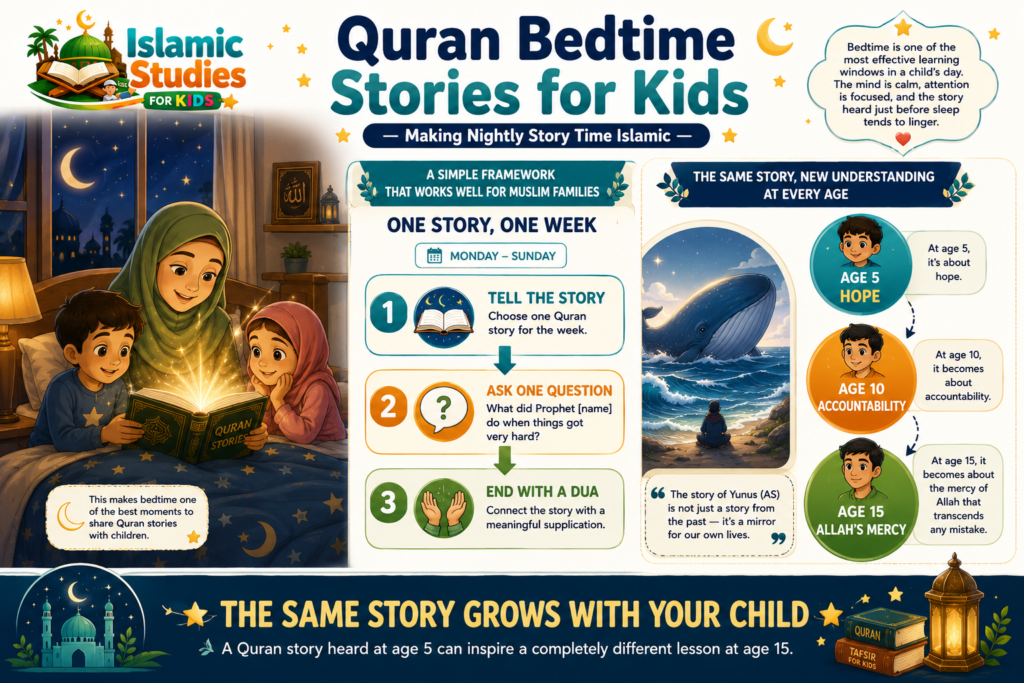
Children who hear the same story multiple times across different ages return to it with new understanding each time. The story of Yunus at age 5 is about hope. At age 10, it becomes about accountability. At age 15, it becomes about the mercy of Allah that transcends any mistake.
The One Thing Most Quran Story Resources Miss
Most articles about Quran stories for kids list the narratives and their morals. What they rarely address is the emotional bridge — the moment where the child moves from hearing a story to feeling its relevance to their own life.
The most effective way to build that bridge is through what might be called the Mirror Question: after telling any Quran story, ask your child, “Has anything like that ever happened to you — where something felt scary or unfair, and then it turned out okay?”
This question connects the prophet’s experience to the child’s own memory. Once a child has made that connection once, they return to that story differently — not as a history lesson, but as a personal reference point for their own faith.
Explore full prophet stories in detail here.
Watch a Sample Lesson from Our Academy
Get a firsthand look at how our students learn Islamic values, Quran, and essential knowledge through engaging and interactive online classes. See why families trust Islamic Studies for Kids Academy.
Read also: Duties of Parents Towards Their Children in Islam
Start Your Child’s Quran Story Journey with Expert Guidance
Stories plant seeds. Expert guidance grows them into something that lasts.
At islamic studies for kids, children aged 4–15 learn Quran stories, Islamic studies, and Quranic Arabic through live, one-on-one online sessions with qualified instructors — people who know how to speak with children, not just at them.
Sessions are 20–30 minutes, scheduled around your family’s routine, and the first lesson is completely free.
[Book Your Child’s Free Trial Lesson →]
Our Islamic Studies Courses Include:
- Islamic Studies for Kids
- Islam Basics for Kids (Beginners)
- 5 Pillars of Islam for Kids
- 6 Pillars of Iman (Faith) for Kids
- Salah (Prayer) for Kids
- Wudu for Kids
- Dua for Kids
- Ramadan for Kids
- Zakat & Sadaqah for Kids
- Hajj for Kids
- Aqeedah (Islamic Belief) for Kids
- Islamic Manners & Akhlaq for Kids
- Good Deeds for Kids
- Cleanliness (Taharah) in Islam for Kids
- Angels in Islam for Kids
- Islamic History for Kids
- Seerah (Prophet’s Life) for Kids
- Prophets Stories for Kids
- Islamic Stories & Morals for Kids
- Fiqh for Kids (Islamic Jurisprudence Basics)
- Hadith for Kids
- Quran Tafseer Course for Kids
- Islamic Holidays & Events for Kids
- Islamic Identity for Kids
- Intensive Islamic Course for Kids
Enroll today and give your child the knowledge, values, and confidence to grow as a practicing Muslim with a strong connection to Allah and His teachings.
Fun & Engaging Islamic Classes for Kids
Start your child’s journey today with interactive lessons designed to make learning Islam loved and easy.
Get Your Child a Free TrialConclusion
Quran stories for kids are not just bedtime entertainment. They are the emotional and spiritual vocabulary children carry into every difficult moment of their lives. A child who knows that Yunus (AS) called on Allah from inside total darkness — and was answered — carries a different kind of confidence than a child who has never heard that story.
The most important thing is not telling these stories perfectly. It is telling them consistently, asking questions that connect the narrative to your child’s life, and making these prophets feel real and near rather than distant and historical.
Prophet Nuh teaches patience. Prophet Yunus teaches hope. Prophet Musa teaches trust. The people of the cave teach courage. Each story is a gift. The Quran preserved them so children — and their parents — could keep returning to them, at every age, and find something new.
Frequently Asked Questions
Why Quran Stories for Kids Are Dif٣ferent from Ordinary Stories?
Quran stories for kids are not fairy tales with invented morals. Each narrative in the Quran actually happened, and every detail was preserved and revealed for a reason.
What makes these stories uniquely powerful for children is the emotional truth at their center. Prophet Yunus (AS) felt trapped and hopeless in total darkness — and called on Allah anyway. Prophet Musa (AS) was placed as a helpless baby in a river by his own mother, terrified but trusting. These are feelings children recognize immediately: fear, loneliness, and the question of whether things will be okay.
Most children’s books give children comfortable stories with comfortable endings. Quran stories give children something more honest — that hardship is real, that Allah is present through it, and that faith produces outcomes that no human plan could have delivered.
What are the best Quran stories for young kids?
The best Quran stories for young children are the ones with strong visual moments and clear emotional arcs: Prophet Nuh and the ark, Prophet Yunus and the whale, Prophet Musa as a baby in the river, and the people of the cave. These stories feature vivid imagery that children can picture easily, and each delivers a single, clear lesson.
At what age should children start learning Quran stories?
Children can begin hearing simplified Quran stories from age 2–3 through picture books and short oral retellings. From age 5–6, they can follow more detailed narratives and begin connecting lessons to their own experiences. Formal study of Quranic context and tafsir is appropriate from around age 10–12.
What is the story of Ashab e Kahf for kids?
The Ashab e Kahf were a group of young believers who refused to worship idols in their city. To protect their faith, they took shelter in a cave and asked Allah for guidance. Allah caused them to sleep for 309 years, preserving them miraculously. When they woke, the world had changed — and their story became a sign of Allah’s power for the people of that era.
Are there animal stories in the Quran for kids?
Yes. The Quran features several animal narratives children love: the hoopoe bird (hud hud) who carried a message for Prophet Sulaiman (AS), the whale that preserved Prophet Yunus (AS), the she-camel of Prophet Salih (AS), and the wolf in Prophet Yusuf’s story. These animals are not background details — they play active roles in the unfolding of Allah’s plan.
What lesson does the story of Prophet Yunus teach children?
The story of Prophet Yunus teaches children that no situation is beyond Allah’s reach, and that sincere dua — especially from a place of real difficulty — is always heard. The dua Yunus made in the whale’s stomach (La ilaha illa anta subhanaka inni kuntu mina adh-dhalimeen) is one children can memorize and use in their own hardest moments.
How do I make Quran stories engaging for a child who finds them boring?
The most effective approach is to start with the child’s feelings, not the story’s facts. Ask: “Have you ever felt like nobody was listening to you?” — then introduce the story of Nuh (AS). Or: “Have you ever been in a really dark, scary place?” — then tell Yunus’s story. When children see themselves in the prophet’s emotional situation first, the story becomes immediately interesting.


Leave a Reply