 For Parents

Most parents put more thought into choosing a maths tutor than a Quran teacher — and it’s an understandable mistake. Quran teachers are often chosen based on proximity, affordability, or a friend’s recommendation. But the stakes are much higher than they appear.
A Quran teacher doesn’t just transmit information. They shape how your child pronounces Arabic for the rest of their life, how they feel about recitation under pressure, and whether they grow up loving the Quran or tolerating it. A child who spends a year with an unqualified teacher will likely need months of remedial correction to undo the habits they’ve developed — habits locked into muscle memory, not just knowledge.
This guide gives you a concrete, practical framework for choosing the best Quran teacher for your child — whether you’re looking locally or exploring online Quran classes for kids.
Choosing a Quran teacher is not the same as choosing any other private tutor. You can switch a maths tutor mid-year and pick up where you left off. Quran recitation works differently — errors that repeat become habits, and habits become the ceiling of your child’s recitation for years. The right decision at the start saves enormous time and prevents the frustration of remedial correction later.
The sections below walk through the five criteria that actually matter — in order of importance.
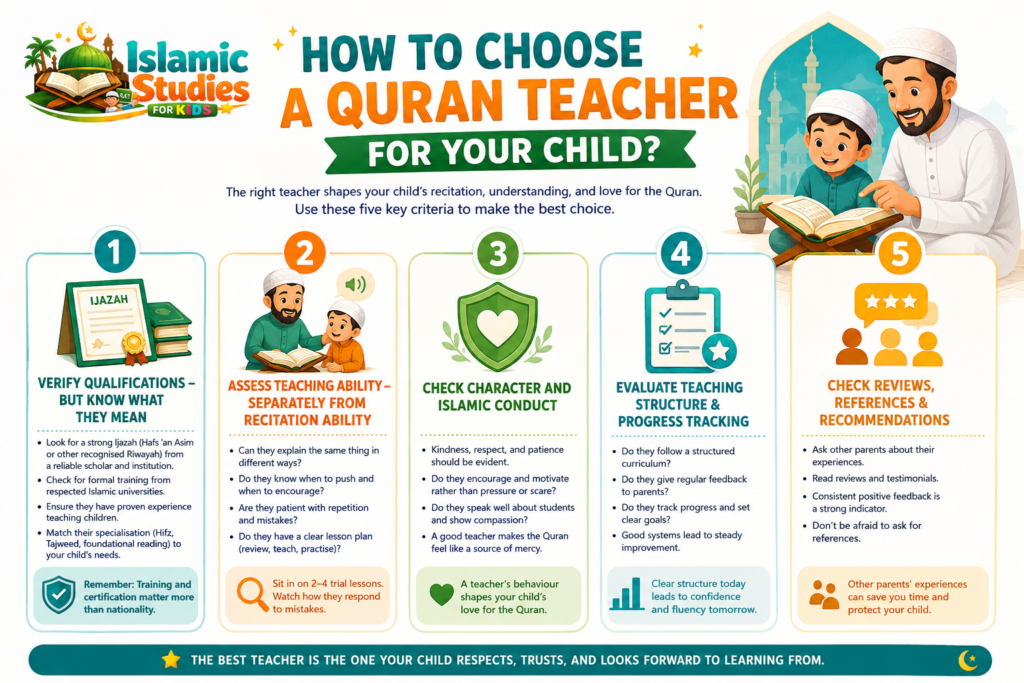
1. Verify Quran Teachers’ Qualifications — But Know What They Mean
The most recognisable credential in Quran education is the Ijazah — a formal certificate documenting an unbroken chain of oral transmission from the teacher back through named scholars to the Prophet ﷺ. A teacher with an Ijazah has had their recitation examined error by error and certified as meeting a defined standard.
However, an important nuance most parents miss: not all Ijazahs are equal. An Ijazah is only as strong as the chain behind it. A teacher may hold a certificate issued by someone whose own recitation was weak. So when a teacher presents an Ijazah, ask: from whom, in which Riwayah, and from which institution? A straightforward answer — “I completed my Ijazah in Hafs ‘an Asim through [named scholar] at [named institution] in [year]” — is the standard you should expect.
Beyond the Ijazah, look for:
- Institutional training — Al-Azhar, Islamic University of Madinah, Darul Uloom, and equivalent institutions have rigorous and structured Tajweed programmes.
- Specific experience with children — this is separate from Quran knowledge. A scholar with flawless recitation who has never taught a seven-year-old is not yet qualified to teach your seven-year-old.
- Specialisation — some teachers excel at Hifz (memorisation); others are better at Tajweed correction or foundational reading. Match the teacher’s strength to your child’s actual need.
One common mistake: parents assume that a native Arabic speaker or someone of Arab origin must be the best reciter. This is not true. Recitation correctness is determined by training, not nationality. Many of the most highly regarded Quran teachers for children in the English-speaking world are not of Arab origin — and some teachers with Arab ancestry carry regional pronunciation habits that Tajweed rules specifically prohibit.
2. Assess Their Teaching Ability — Separately from Recitation Ability
Correct recitation and the ability to teach are two entirely different skills. Being able to read the Quran, even at a high level, does not mean a person can diagnose a child’s error, explain it in terms a child understands, or keep an eight-year-old engaged through fifteen repetitions of the same sound.
Teaching children specifically requires:
- The ability to explain one thing in multiple ways — if the first explanation doesn’t land, a good teacher tries a different angle, a different example, a different comparison.
- Knowing when to push and when to support — a child who is struggling needs encouragement before correction; a child who is bored needs challenge.
- Patience under repetition — Tajweed correction is inherently repetitive. A teacher who shows frustration when a child repeats the same error is not yet ready to teach children.
- Structured lessons — a good session has a clear plan: review previous material, introduce new material, practise. If every session feels improvised, there is no curriculum.
The fastest way to assess this is to observe a trial lesson. Watch how the teacher responds when your child makes the same mistake twice. Do they explain from a new angle? Do they use a sound comparison (“listen — that qaaf comes from further back in the throat, like this”)? Or do they repeat the same correction with rising impatience? The child learns more from the teacher’s reaction than from the information itself.
If you enrol your child in online Quran classes, sit in on the first two to four sessions. You are not there to micro-manage — you are there to make an informed judgment about whether this person can guide your child.
3. Check The Teacher’s Character and Islamic Conduct
This is harder to assess than qualifications, but it matters. A Quran teacher is not simply delivering a service — they are modelling what an Islamic teacher looks like. Children absorb this. A teacher who smiles, praises effort, and corrects gently teaches the child that the Quran is a source of mercy. A teacher who shouts, shames, or uses fear as motivation teaches something entirely different.
The basics to look for:
- Does the teacher speak kindly about students (including past ones)?
- Do they describe “strictness” as though it is a virtue in itself, without mentioning compassion?
- Do they use rewards, encouragement, and positive reinforcement rather than pressure?
Al-Ghazali’s principle that a teacher should calibrate to the student’s level, show gentleness, and treat each student with the same care they would wish for themselves — is not just religious philosophy. It describes effective pedagogy for children. A teacher who embodies this produces students who want to continue. A teacher who relies on harshness produces students who endure it until they can stop.
One practical red flag: if you ever hear a teacher speak dismissively about a struggling student (“she just doesn’t try,” “he has no focus”), consider it a serious warning. A qualified child educator understands that when a child repeatedly fails to grasp something, the instructional method needs to change — not the child.
4. Ensure That Teachers Know How To Deal With Kids
Online Quran classes for kids have become the default option for many families — and for good reason. They eliminate commute time, offer flexible scheduling, and give access to teachers across the world who would otherwise be unreachable.
But online teaching also introduces risks that in-person settings don’t have.
A. Language compatibility
is the biggest one most parents overlook. Many families hire teachers from countries where costs are lower — a reasonable financial decision — but if the teacher and child cannot communicate clearly about how sounds are produced, the language barrier becomes a wall. Describing sounds is genuinely difficult (“that dhaad is articulated from the side of the tongue against the upper molars”) — adding a language gap makes it nearly impossible for a young child to understand.
B. Monitoring access
matters more online than in person. You should always have the ability to sit in on any session, at any time, without advance notice. A teacher or platform that discourages parental observation during online sessions is a red flag.
Read also: How To Teach Your Child The Arabic Alphabet?
Experience a Real Classroom
Curious about how we teach? This video offers a glimpse into a real class, showcasing our interactive approach, qualified teachers, and child-friendly learning experience.
Fun & Engaging Islamic Classes for Kids
Start your child’s journey today with interactive lessons designed to make learning Islam loved and easy.
Get Your Child a Free Trial5. Choose Teachers with Progress tracking Methods
is the structural difference between a professional online platform and an individual tutor with a Zoom link. A professional setup includes written session notes, a clear record of which surahs or sections have been covered, Tajweed weaknesses being worked on, and regular communication with parents — not just occasional WhatsApp messages.
When evaluating what to look for in an online Quran teacher for kids, ask these questions before committing:
- What is the lesson structure? How much time is review, how much is new material, how much is practice?
- How do you correct Tajweed errors during a live session?
- What do parents receive at the end of each month to track progress?
- Is there a level assessment before the first lesson?
- Can I sit in on any session at any time?
If a teacher or platform cannot answer these questions clearly, find one that can.
Looking for a structured starting point? Explore our Quran learning resources for kids to understand the stages your child will move through — from alphabet recognition to full recitation.
6. Do a Trial Lesson — and Know What to Watch For
A trial lesson is the most reliable information you will get about a teacher. Credentials and interviews show you what a teacher knows. A trial lesson shows you what a teacher does.
During the trial, observe three things:
A. How your child responds
Does your child speak freely? Do they smile? When the session ends, do they seem relieved or engaged? A child who says “can we do it again?” has given you the clearest possible recommendation. A child who asks how much longer it will be has given you the opposite.
How the teacher corrects errors
A good teacher says: “Listen to me once — now you try. Good effort — let’s try that part again.” A teacher who simply repeats the same instruction louder, or who sighs when a child makes an error, is showing you their default response to failure. That response will appear in every session that follows.
Whether the teacher assesses before teaching
A qualified teacher does not assume they know your child’s level. They listen to your child recite first — even in a trial — before deciding where to begin. A teacher who jumps straight into new material without assessing where your child currently is has no basis for their instruction.
After the session, ask your child two questions only: “What did you like most?” and “Was there anything you didn’t understand?” Their answers will tell you more than any checklist.
7. Red Flags: When to Walk Away?
Even a highly credentialed teacher may not be right for your child. These warning signs should give you pause regardless of qualifications:
- They cannot explain their Tajweed training clearly: “I’ve always been able to read” is not a training history.
- They describe themselves as strict without mentioning patience or kindness: Strictness and harshness are not the same thing — a good teacher knows the difference.
- They refuse a trial lesson or want full payment upfront: Any reputable teacher offers a trial. Resistance to this is a signal.
- They do not communicate with parents: If the only update you ever get is the invoice, your child’s progress is invisible.
- Sessions are unstructured every time: An improvised lesson occasionally is human. Improvised lessons every week mean there is no plan.
- They speak dismissively about previous students: How they talk about other children tells you exactly how they think about yours.
- They promise unusually fast Hifz completion: “Complete in one year” promises typically sacrifice Tajweed quality for pace — and create gaps that surface much later.
Read also: How To Teach Your Child To Pray (Salah)?
Watch a Sample Lesson from Our Academy
Get a firsthand look at how our students learn Islamic values, Quran, and essential knowledge through engaging and interactive online classes. See why families trust Islamic Studies for Kids Academy.
Start Your Child’s Quran Journey with Confidence
Choosing well at the start is the single highest-return investment in your child’s Quran education. The right teacher builds correct recitation habits, a structured revision system, and — most importantly — a child who looks forward to their next lesson.
If you’re ready to find a qualified, child-focused Quran teacher for your child, explore Islamic Studies for Kids — resources designed for children at every stage of their Quran journey.

Our Islamic Studies Courses for Kids:
- Quran for Kids
- Noorani Qaida for Kids
- Quran Recitation for Kids
- Tajweed for Kids
- Quran Memorization (Hifz) for Kids
- Quran for Toddlers
- Quranic Arabic for Kids
- Quran Stories for Kids
Fun & Engaging Islamic Classes for Kids
Start your child’s journey today with interactive lessons designed to make learning Islam loved and easy.
Get Your Child a Free TrialConclusion
Choosing a Quran teacher is one of the most consequential educational decisions you will make for your child — not because it is dramatic, but because its effects are long-lasting and difficult to reverse. Pronunciation habits formed in the first years of Quran learning stay with a child for decades. A teacher who builds those habits correctly creates a foundation for beautiful, confident recitation. A teacher who doesn’t creates work that another teacher will have to undo.
The five criteria covered in this guide — verifiable qualifications, genuine teaching ability, sound character, structured online delivery, and a trial lesson — give you a practical framework for making this decision with confidence. Credentials matter, but they are the start, not the end. How the teacher speaks to your child in the first fifteen minutes of a trial lesson tells you more than a CV ever will.
Take the time to ask the questions. Do the trial. And trust your child’s reaction — they will tell you everything you need to know.
Frequently Asked Questions
Does a Quran teacher need an Ijazah to teach children?
An Ijazah is the gold standard — it documents that a teacher’s recitation was personally verified through a chain of scholars. Not every qualified teacher will hold one, but every teacher should be able to explain exactly where and from whom they learned, and their Tajweed should be demonstrably correct. For Hifz supervision especially, an Ijazah is a strong expectation.
What is the most important quality in an online Quran teacher for kids?
The ability to teach children — not just recite correctly — is the most critical quality. A teacher who can diagnose errors, explain corrections in language a child understands, and maintain patience through repetition will produce better results than a flawless reciter who has never worked with young learners.
How many trial lessons should I do before committing?
Two to four trial sessions give you enough information to make a reliable judgment. One session can catch obvious problems, but it takes two or three lessons to see how the teacher responds on an ordinary day — when the novelty has worn off and the real teaching rhythm begins.
Is it okay for a girl to have a male Quran teacher?
For younger children, the gender of the teacher matters less than their qualifications and child-teaching ability. For girls who have reached puberty, most families prefer a female teacher — both for religious appropriateness and because it creates a more comfortable environment for voice-related learning. Most reputable online platforms offer gender-matched teachers as the default.
What should my child be doing between Quran lessons?
A short daily home routine of 10–15 minutes makes a significant difference. This should include reviewing whatever was covered in the last session (5 minutes), listening to a clear recitation of the same material (5 minutes), and one specific word of praise from a parent. Consistency between sessions accelerates progress more than any other factor a parent controls.
How do I know if my child’s Tajweed is being taught correctly?
Record your child reciting and share it with two or three people from different backgrounds who have a strong Quran reading. Ask them to flag any errors they hear. A single opinion can reflect regional habits; multiple independent listeners reduce that bias. If you consistently hear the same errors flagged, raise them directly with the teacher and assess how they respond.



Leave a Reply