 Islamic Studies
Teaching your child Salah is one of the most beautiful gifts you can give them. But when your little one struggles to remember how many Rakats are in each prayer, you may worry that learning Salah will feel confusing or overwhelming instead of peaceful and meaningful.
Every parent wants to see their child pray with confidence, knowing when to stand, bow, and prostrate without constantly asking what comes next. The good news is that learning how many Rakats in each Salah for kids doesn’t have to be difficult. A few simple explanations and a little daily practice can make a big difference.
In this guide, you’ll find an easy Rakat chart covering all five daily prayers, clear explanations of Fard and Sunnah Rakats, and simple step-by-step instructions. You’ll also discover fun ways to help your child remember the prayer numbers and build a lifelong love for Salah.
What Is a Rakat in Salah?
A Rakat (ركعة) is one complete unit of Islamic prayer. Every Salah contains a specific number of Rakats, and each Rakat includes standing, bowing, and prostrating before Allah.
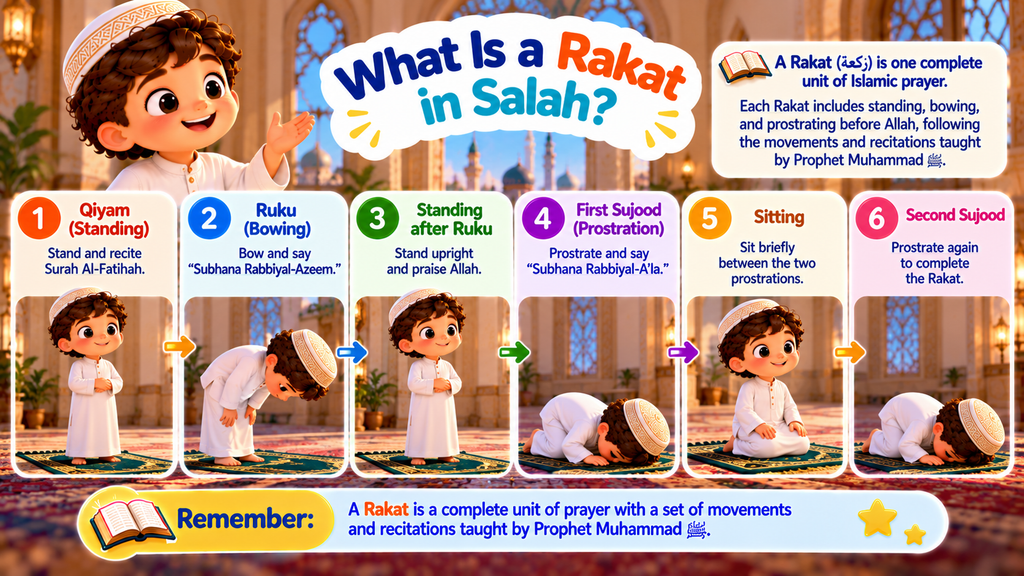
When Muslims perform one Rakat, they follow a set of prayer movements and recitations taught by Prophet Muhammad (peace be upon him).
Here are the main parts of one Rakat:
- Qiyam (Standing): Stand and recite Surah Al-Fatihah.
- Ruku (Bowing): Bow and say “Subhana Rabbiyal-Azeem.”
- Standing after Ruku: Stand upright and praise Allah.
- First Sujood (Prostration): Prostrate and say “Subhana Rabbiyal-A’la.”
- Sitting: Sit briefly between the two prostrations.
- Second Sujood: Prostrate again to complete the Rakat.
A child can remember that every Rakat has one Ruku and two Sujoods Learning these movements is an important part of understanding the basics of Islam for kids.

How Many Rakats in Each Salah for Kids? Complete Chart?
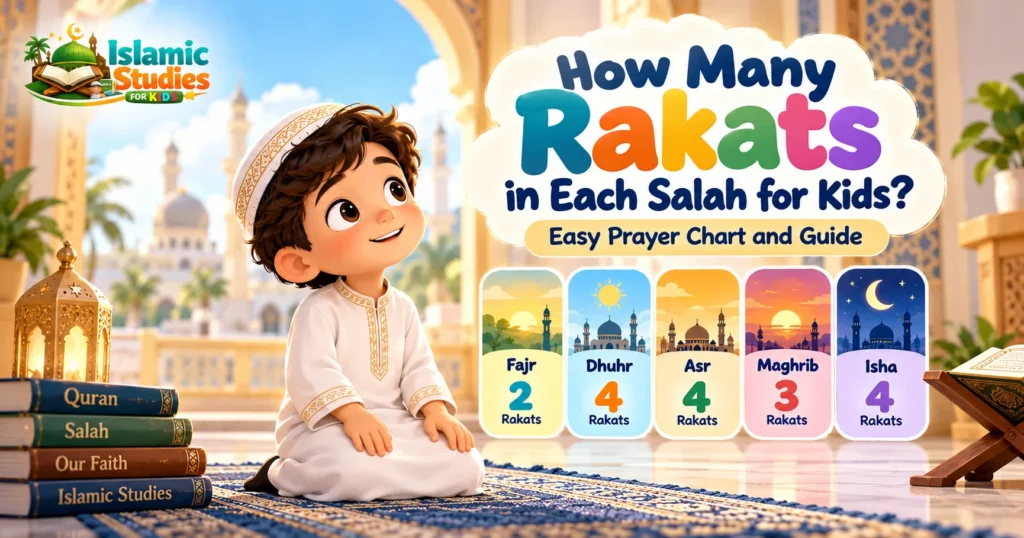
Muslims perform five obligatory prayers every day. Each Salah has a specific number of Fard Rakats, making a total of 17 obligatory Rakats daily.
This simple rakat chart for kids helps children remember how many Rakats are in Fajr, Dhuhr, Asr, Maghrib, and Isha.
| Salah | Time of Prayer | Fard Rakats |
| Fajr (الفجر) | Early morning, before sunrise | 2 Rakats |
| Dhuhr (الظهر) | After midday | 4 Rakats |
| Asr (العصر) | Afternoon | 4 Rakats |
| Maghrib (المغرب) | After sunset | 3 Rakats |
| Isha (العشاء) | Night | 4 Rakats |
| Total | Five daily prayers | 17 Rakats |
The chart shows only obligatory Rakats. Sunnah and voluntary prayers are additional.
Easy Ways to Remember the Salah Rakats
Children can memorize the five daily prayers by noticing these simple patterns:
- Fajr is the only daily obligatory prayer with 2 Rakats.
- Dhuhr, Asr, and Isha each have 4 Rakats.
- Maghrib is the only daily obligatory prayer with 3 Rakats.
Another helpful way to remember is to repeat the numbers in prayer order:
2 – 4 – 4 – 3 – 4
For prayers with three or four Rakats, Muslims sit for the first Tashahhud after the second Rakat, then complete the remaining Rakats. Every Salah ends with the final Tashahhud and Tasleem.
Children can start by memorizing these numbers before learning the additional Sunnah prayers and the complete steps of Salah.
For children who need guided practice, the Salah for Kids Course helps them learn daily prayers, movements, recitations, and prayer habits step by step.

What Does the Quran Say About the Five Daily Prayers?
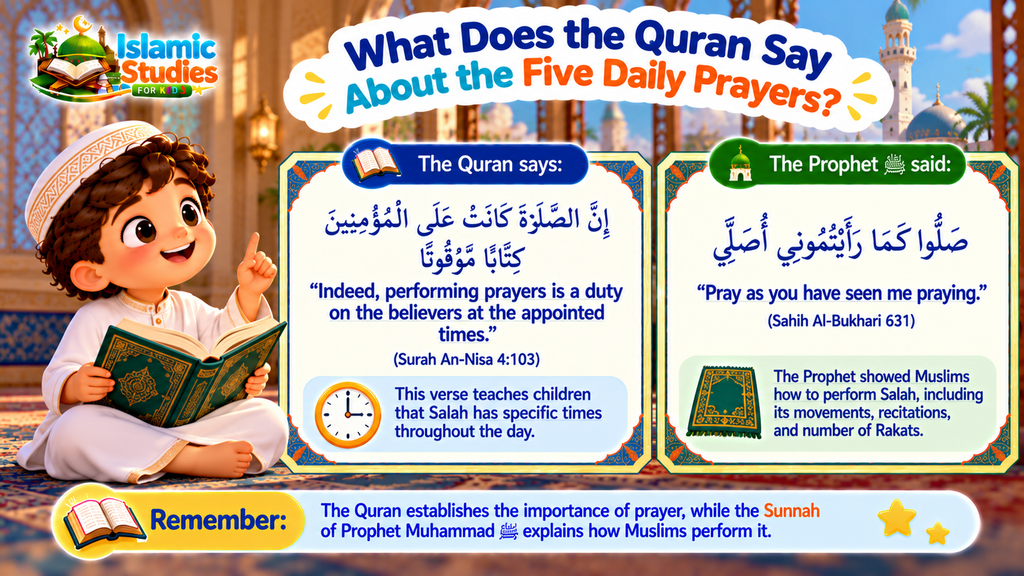
Allah teaches Muslims that Salah must be performed at appointed times.
Allah says:
إِنَّ الصَّلَاةَ كَانَتْ عَلَى الْمُؤْمِنِينَ كِتَابًا مَّوْقُوتًا
“Indeed, performing prayers is a duty on the believers at the appointed times.”
This verse teaches children that Salah has specific times throughout the day.
The Quran establishes the importance of prayer, while the Sunnah of Prophet Muhammad (peace be upon him) explains how Muslims perform it.
The Prophet (peace be upon him) said:
صَلُّوا كَمَا رَأَيْتُمُونِي أُصَلِّي
“Pray as you have seen me praying.”
The Prophet showed Muslims how to perform Salah, including its movements, recitations, and number of Rakats.
Children can explore Quranic meanings further through Tafseer lessons for kids, which help them understand what Allah teaches in the Quran.

What Is the Difference Between Fard, Sunnah, and Nafl Rakats?
Muslims can pray additional Rakats before or after their five daily prayers. These Rakats fall into three main categories:
- Fard Rakats (Obligatory): Prayers Muslims are required to perform, totaling 17 Rakats daily.
- Sunnah Rakats (Recommended): Additional prayers taught and practiced by Prophet Muhammad (peace be upon him).
- Nafl Rakats (Voluntary): Extra prayers Muslims can perform to seek Allah’s reward.
Simple Fard and Sunnah Rakat Chart for Kids
The following chart shows the obligatory Rakats alongside the regular Sunnah prayers and other recommended prayers.
| Salah | Fard Rakats | Sunnah and Recommended Rakats |
| Fajr | 2 | 2 before |
| Dhuhr | 4 | 2 or 4 before, 2 after |
| Asr | 4 | 4 before (recommended) |
| Maghrib | 3 | 2 after |
| Isha | 4 | 2 after |
The regular Sunnah prayers total 10 or 12 Rakats, depending on whether two or four are prayed before Dhuhr. The four recommended Rakats before Asr are additional and are not included in this total.
What about Witr?
Witr is a separate night prayer performed after Isha and before Fajr. Its number of Rakats and method of performance vary among Islamic schools of thought.
For children learning Salah, the best starting point is to memorize the 17 obligatory Rakats before gradually learning Sunnah and voluntary prayers.
How to Perform One Rakat of Salah Step by Step?
Each Rakat follows a series of movements and recitations. Here are the basic steps children can learn and practice. Understanding these steps helps kids become familiar with the order of Salah and feel more confident when praying. Parents can demonstrate each movement and encourage children to practice gradually until they remember the sequence.
Step 1: Face the Qiblah, Say Allahu Akbar, and Recite Al-Fatihah
Stand facing the Qiblah, make your intention to pray in your heart, and begin by saying “Allahu Akbar.” Recite Surah Al-Fatihah, followed by another passage from the Quran in the first two Rakats.
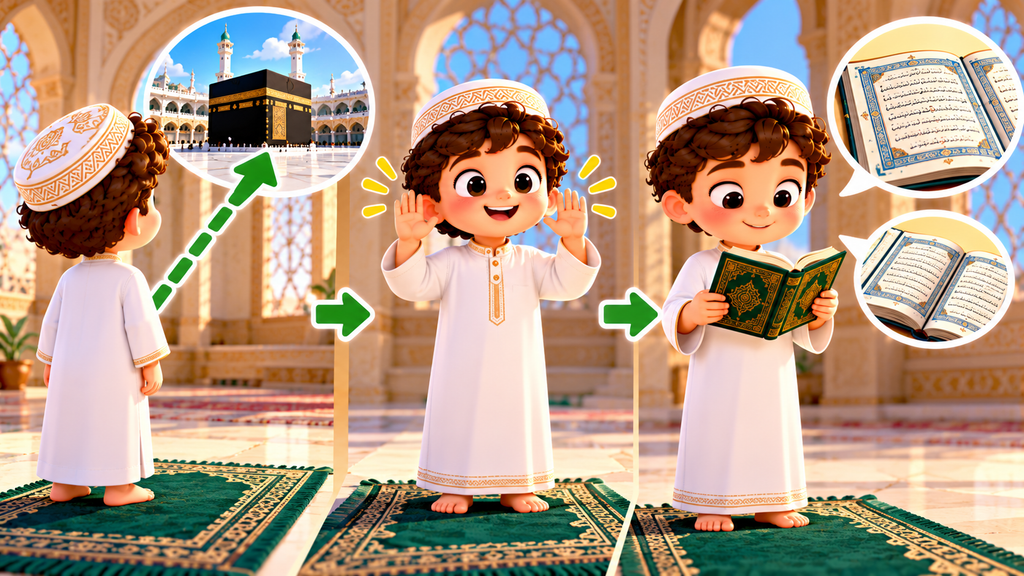
The Qiblah is the direction of the Kaaba in Makkah, which Muslims face during Salah. Children should learn to stand calmly and focus on their prayer. Parents can help them memorize Surah Al-Fatihah by practicing a few verses at a time.
Short Surahs, such as Al-Ikhlas or Al-Kawthar, are also useful for beginners. Remind children that the intention is made in the heart and does not need to be spoken aloud.
Step 2: Bow in Ruku and Praise Allah
Bend forward with your hands on your knees and say “Subhana Rabbiyal-Azeem,” meaning “Glory be to my Lord, the Most Great.”
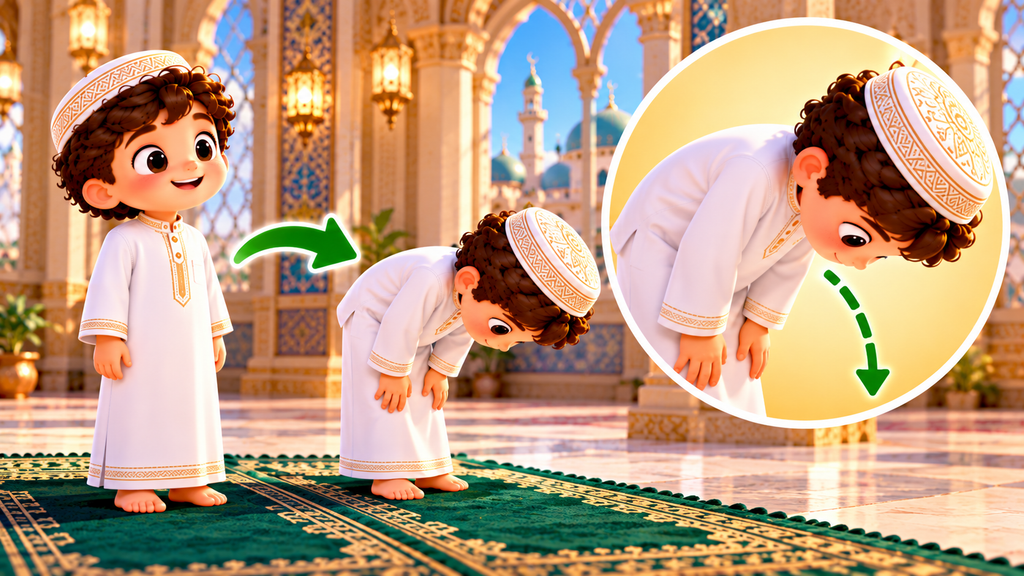
During Ruku, children should keep their backs reasonably straight and their hands resting on their knees. This position teaches humility and respect before Allah.
Parents can demonstrate the correct posture and help children pronounce the Arabic words slowly. Practicing the movement outside prayer time allows younger children to become comfortable with it without feeling rushed.
Watch a Sample Lesson from Our Academy
Get a firsthand look at how our students learn Islamic values, Quran, and essential knowledge through engaging and interactive online classes. See why families trust Islamic Studies for Kids Academy.
Fun & Engaging Islamic Classes for Kids
Start your child’s journey today with interactive lessons designed to make learning Islam loved and easy.
Get Your Child a Free TrialStep 3: Rise from Ruku and Stand Upright
Stand up straight while saying “Sami’ Allahu liman hamidah,” then say “Rabbana wa lakal-hamd” to praise Allah.
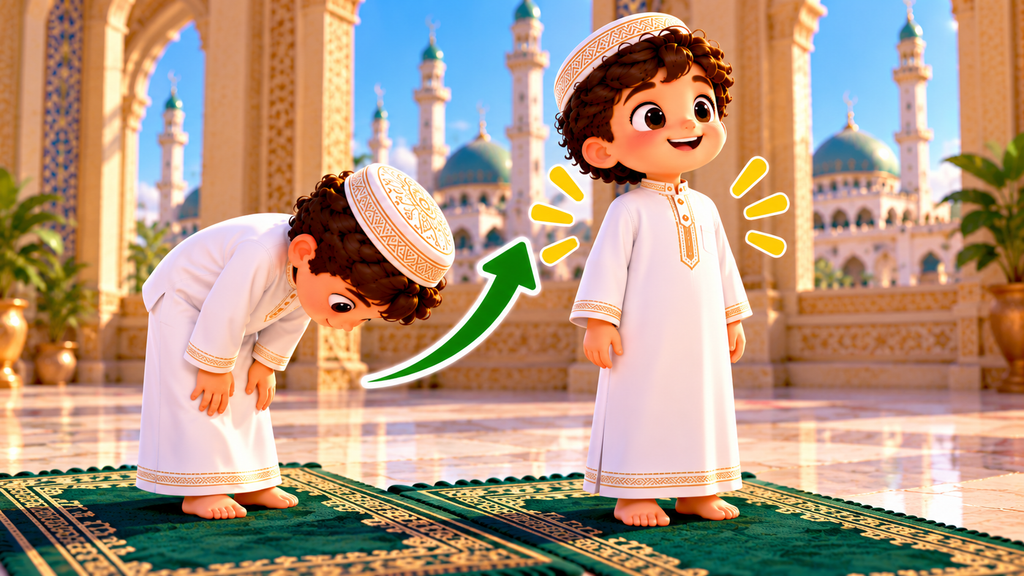
The first phrase means “Allah hears those who praise Him,” while the second means “Our Lord, to You belongs all praise.” Children can learn that this part of Salah is an opportunity to praise and thank Allah.
Encourage them to stand fully upright before moving into Sujood. Parents can practice both phrases with their children until they become familiar with the words and their meanings.
Step 4: Perform the First Sujood and Glorify Allah
Prostrate with your forehead and nose touching the ground and say “Subhana Rabbiyal-A’la,” meaning “Glory be to my Lord, the Most High.”
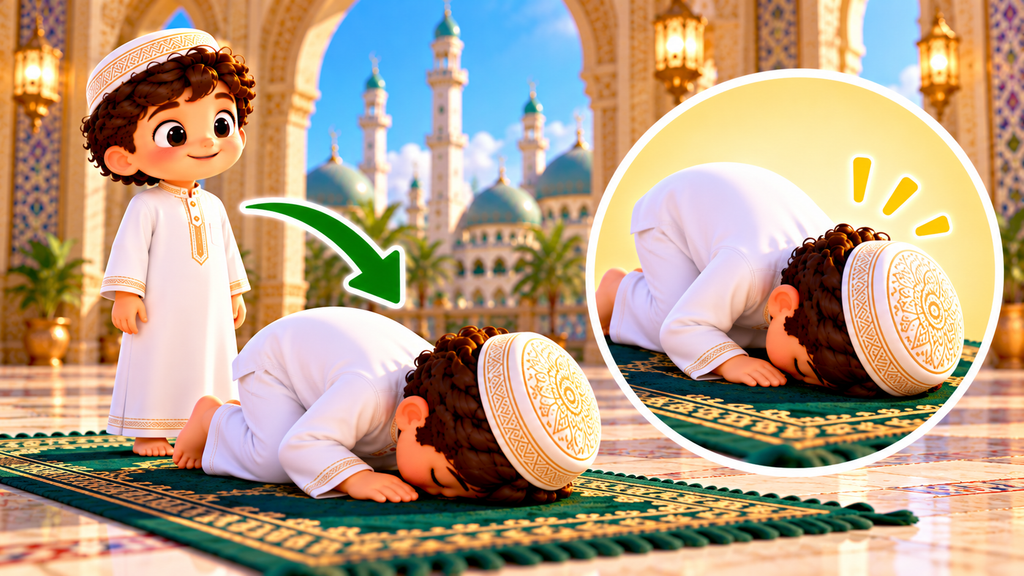
In Sujood, children place their forehead, nose, palms, knees, and toes on the ground. This position represents humility and submission to Allah.
Parents can explain that Sujood is a special moment of worship when Muslims draw close to their Lord. Encourage children to perform the movement gently and remain still long enough to recite the words calmly.
Step 5: Sit Between the Two Sujoods and Ask Allah for Forgiveness
Rise from the first Sujood, sit briefly, and say “Rabbighfir li,” meaning “My Lord, forgive me.”
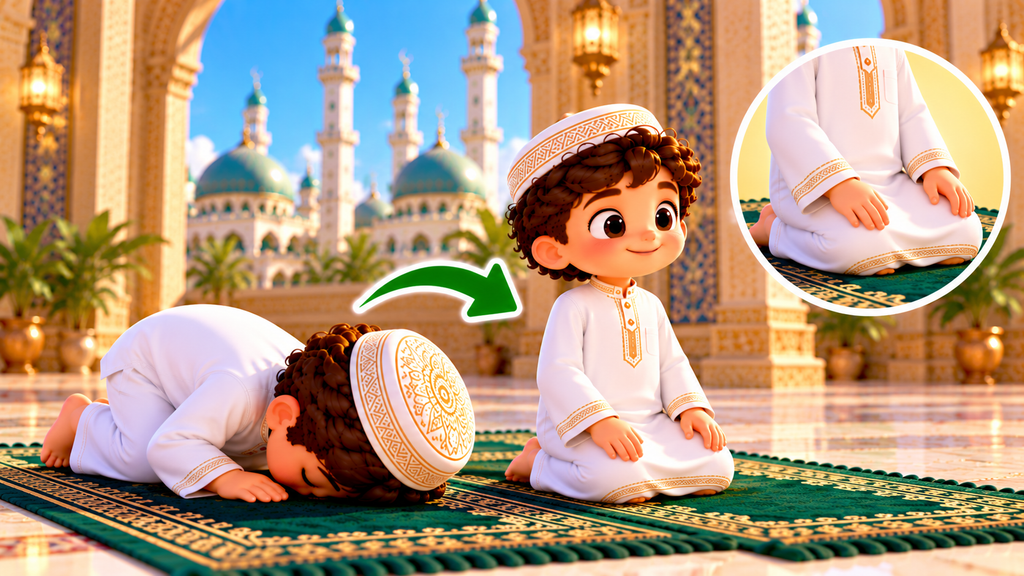
Children should learn to sit calmly between the two prostrations rather than rushing into the next movement. Parents can explain that asking Allah for forgiveness is an important part of Muslim worship.
This short supplication is easy for young learners to memorize and provides an opportunity to introduce the meaning of seeking Allah’s mercy. Practicing the sitting position separately can also help children remember the correct prayer sequence.
Step 6: Perform the Second Sujood to Complete One Rakat
Prostrate again and repeat “Subhana Rabbiyal-A’la.” This completes one Rakat. Stand to begin the next Rakat if more remain.
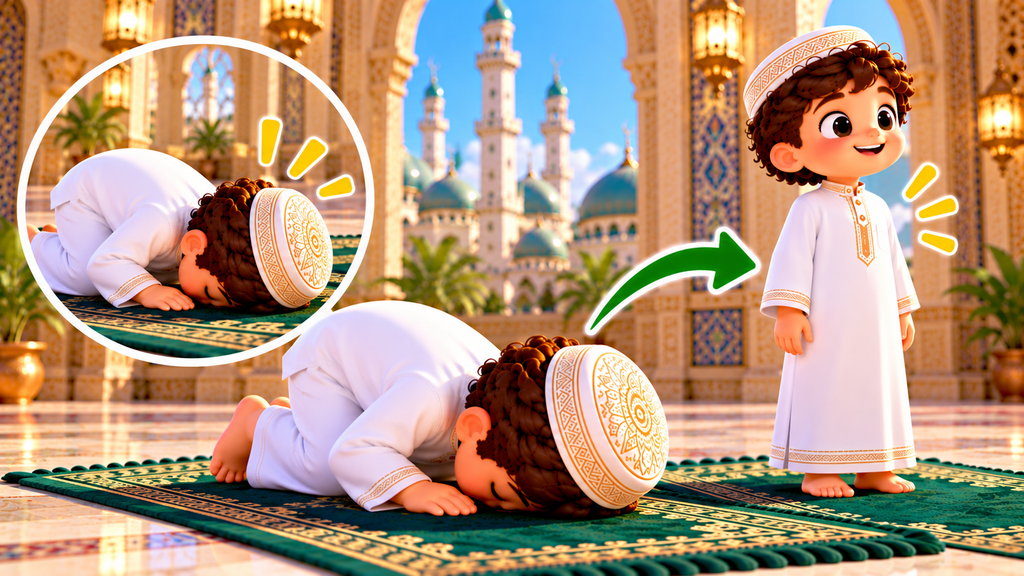
Explain to children that every Rakat includes one Ruku and two Sujoods. Parents can use a simple illustrated Salah chart to help children recognize these movements and remember their order. After the second Sujood, the next action depends on the position within the prayer: the worshipper may stand for another Rakat or sit for Tashahhud.
After the final Rakat, Muslims sit for the final Tashahhud and end the prayer with Tasleem, saying “Assalamu Alaikum wa Rahmatullah” while turning to the right and then to the left.
How Can Kids Memorize the Number of Rakats Easily?
Learning the Salah Rakat numbers does not have to be difficult. Parents can use simple activities to help children remember all five daily prayers. Visual reminders, repetition, and hands-on games can make memorization easier and more enjoyable. By practicing a little every day, children can gradually learn the correct number of obligatory Rakats for each Salah.
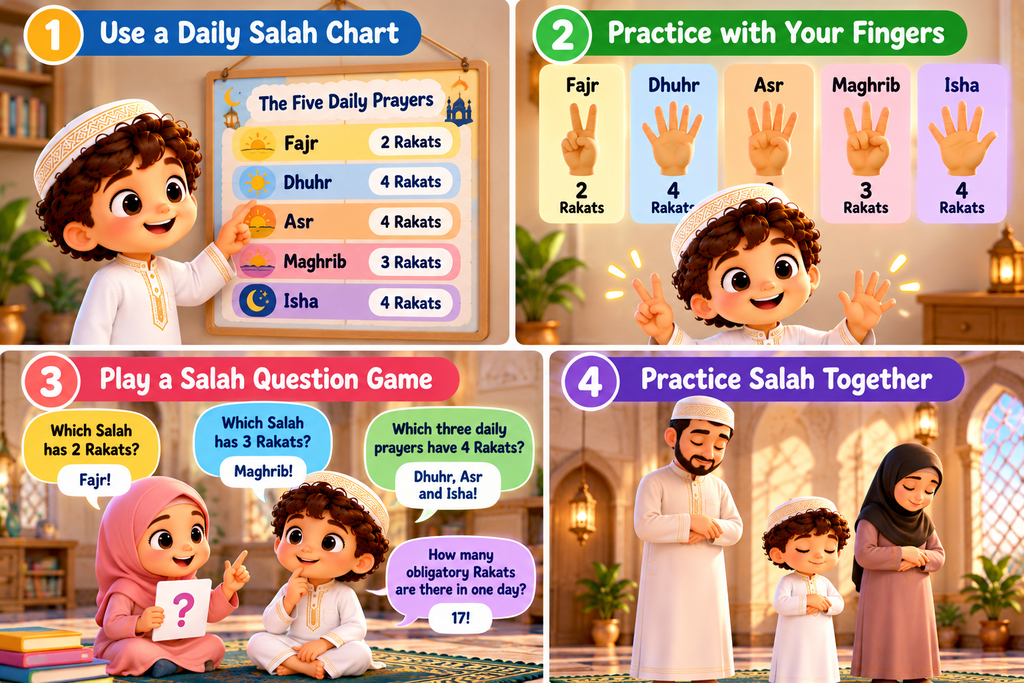
Use a Daily Salah Chart
Create a colorful chart with the names of the five prayers and their obligatory Rakats. Place it somewhere your child can see every day. Children can look at the chart before each prayer and say the number of Rakats aloud.
To make the chart more engaging, use different colors or symbols for each prayer. For example, children can draw two stars next to Fajr, three next to Maghrib, and four next to Dhuhr, Asr, and Isha. Parents can also encourage children to check the chart after answering questions to reinforce their memory. Over time, they may begin to remember the numbers without needing to look.
Practice with Your Fingers
Ask your child to show the number of Rakats using their fingers. For example, show two fingers for Fajr, four for Dhuhr, four for Asr, three for Maghrib, and four for Isha.
This simple counting activity helps young children connect prayer names with numbers. Parents can call out a prayer name and ask their child to quickly hold up the correct number of fingers. To make the activity more challenging, reverse the game by showing a number and asking which prayers have that many Rakats. This approach combines visual learning, movement, and repetition.
Play a Salah Question Game
Make learning interactive with questions such as:
- Which Salah has 2 Rakats? Fajr.
- Which Salah has 3 Rakats? Maghrib.
- Which three daily prayers have 4 Rakats? Dhuhr, Asr, and Isha.
- How many obligatory Rakats are there in one day? 17.
Repeating these questions regularly helps children remember the numbers.
Parents can turn this into a quick quiz during family time or after Salah. Use small flashcards with prayer names on one side and Rakat numbers on the other. Children can also arrange the cards in the correct prayer order or match each prayer to its number of obligatory Rakats. Keep the questions simple at first, then gradually introduce more challenging ones as their confidence grows.
Practice Salah Together
Children often learn prayer by watching their parents. Invite your child to join you during Salah, watch the movements, and gradually practice the correct sequence.
Praying together helps children understand that a Rakat includes standing, bowing, and prostration. Parents can explain the sequence outside prayer time and help children count the Rakats during practice sessions. For example, demonstrate two Rakats of Fajr and then explain how Dhuhr includes four obligatory Rakats.
Keep the experience encouraging and age-appropriate so that learning Salah becomes a positive part of their daily life. Regular practice, gentle reminders, and praise for their efforts can help children remember the Rakat numbers while developing a stronger connection with daily prayer.
How Many Rakats Are in Jumu’ah Prayer?
Jumu’ah is the congregational Friday prayer. It takes the place of the regular Dhuhr prayer for Muslims who are required to attend it. Jumu’ah has 2 obligatory Rakats, performed in congregation after the Friday Khutbah (sermon).
Children should understand the difference:
- Regular Dhuhr prayer has 4 Fard Rakats.
- Jumu’ah prayer has 2 Fard Rakats and is preceded by the Khutbah.
Jumu’ah does not replace all five daily prayers. Fajr, Asr, Maghrib, and Isha remain part of the daily prayer schedule.
Experience a Real Classroom
Curious about how we teach? This video offers a glimpse into a real class, showcasing our interactive approach, qualified teachers, and child-friendly learning experience.
Fun & Engaging Islamic Classes for Kids
Start your child’s journey today with interactive lessons designed to make learning Islam loved and easy.
Get Your Child a Free TrialHelp Your Child Build a Strong Foundation in Salah with Islamic Studies for Kids Academy
Learning how many Rakats are in each Salah is just the beginning of your child’s journey toward understanding Islamic prayer. As a parent, you want your child to do more than memorize numbers. You want them to understand the meaning of Salah, perform it with confidence, and develop a genuine love for worship.
At Islamic Studies for Kids Academy, we help children build a strong Islamic foundation through engaging, age-appropriate lessons and supportive guidance. From understanding the five daily prayers to learning essential Islamic values, our approach makes Islamic education simple, meaningful, and enjoyable for young learners.
Give your child a confident start in their Islamic learning journey. Book a free trial lesson today and discover how Islamic Studies for Kids Academy can make a difference.
Our Islamic Studies Courses Include:
- Islamic Studies Course for Kids
- Islam Basics Course for Kids
- 5 Pillars of Islam Course for Kids
- 6 Pillars of Iman (Faith) Course for Kids
- Salah (Prayer) Course for Kids
- Wudu Course for Kids
- Dua Course for Kids
- Ramadan Course for Kids
- Zakat & Sadaqah Course for Kids
- Hajj Course for Kids
- Aqeedah (Islamic Belief ) Course for Kids

Conclusion
Learning how many Rakats are in each Salah for kids is an important step toward understanding the five daily prayers. By remembering the simple pattern of 2, 4, 4, 3, and 4, children can recognize the 17 obligatory Rakats and begin to understand the difference between Fard, Sunnah, and Nafl prayers.
Remembering the numbers is only the beginning. As children become familiar with the movements, recitations, and prayer times, they gradually gain the confidence to perform Salah correctly. Using a simple Rakat chart, practicing together, and reviewing each prayer regularly can make learning easier.
Most importantly, learning Salah should be a positive experience. With patience, gentle guidance, and consistent practice, children can develop good prayer habits and a deeper connection with Allah that stays with them as they grow.
Frequently Asked Questions About Salah Rakats for Kids
How many Rakats are in each of the five daily prayers?
Fajr has 2 Fard Rakats, Dhuhr has 4, Asr has 4, Maghrib has 3, and Isha has 4. Together, they make 17 obligatory Rakats each day.
Which Salah has only 2 Rakats?
Fajr has 2 obligatory Rakats. The Friday Jumu’ah prayer also has 2 obligatory Rakats when performed in congregation.
Which Salah has 3 Rakats?
Maghrib is the only obligatory daily prayer with 3 Rakats. Muslims perform it after sunset.
Which Salah has 4 Rakats?
Dhuhr, Asr, and Isha each have 4 obligatory Rakats in their regular form. Certain travel-related rulings can change the number performed.
How many Rakats should kids learn first?
Children should begin by learning the Fard Rakats of the five daily prayers. After memorizing these, they can learn the Sunnah prayers and other details gradually.
At what age should children start learning Salah?
Prophet Muhammad (peace be upon him) instructed parents to teach their children prayer from the age of seven. Children can begin learning the names, movements, and numbers of Rakats even earlier when they are ready.
Do Sunnah Rakats count toward the 17 daily Rakats?
No. The 17 daily Rakats include only the obligatory Fard prayers. Sunnah and Nafl prayers are additional.



Leave a Reply