 Islamic Studies
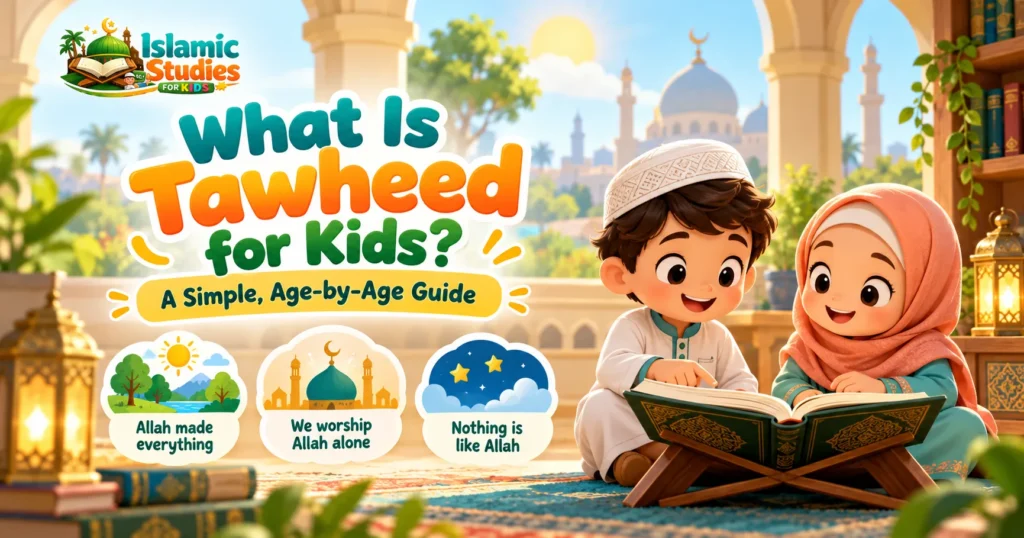
Tawheed means believing that Allah is One. He alone created everything, He alone takes care of everything, and He alone deserves our worship. Nothing and no one is like Him.
That is the simple answer to what is tawheed for kids. It is the most important belief in Islam and the first thing every Muslim child learns about Allah. In this guide, we explain it step by step in easy words, with examples from daily life, so children can understand it and parents can explain it with confidence.
What Does Tawheed Mean?
Tawheed is an Arabic word. It comes from wahid, which means “one.” So Tawheed is about the Oneness of Allah: there is only one Allah, and there is nobody like Him.
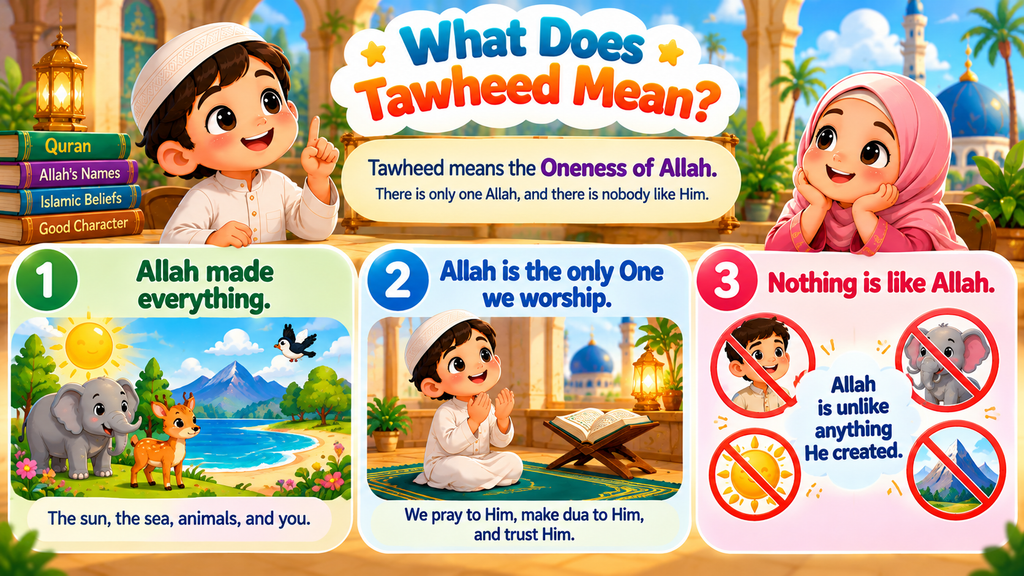
Here is the tawheed meaning for kids in three short sentences:
- Allah made everything. The sun, the sea, animals, and you.
- Allah is the only One we worship. We pray to Him, make dua to Him, and trust Him.
- Nothing is like Allah. He is not like people, animals, or anything we can imagine.
These three ideas are the oneness of Allah for kids in its simplest form. Allah is not one of many gods. He is not a person in the sky. He is the One who made everything and cares for everything.
Why Is Tawheed So Important?
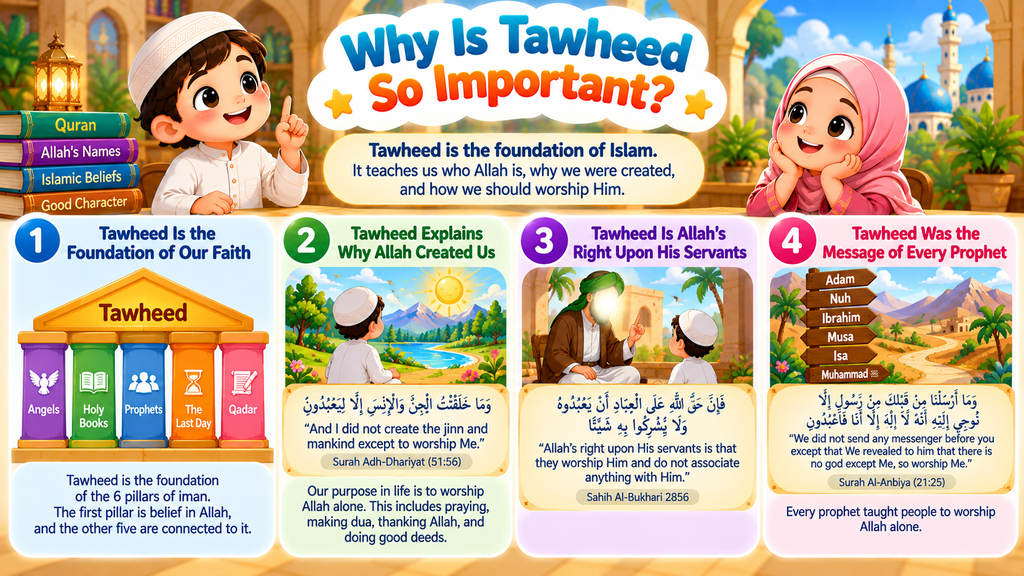
Tawheed is the foundation of Islam and the most important belief every Muslim child should learn. It teaches us who Allah is, why we were created, and how we should worship Him.
Understanding Tawheed helps children build a strong relationship with Allah and recognize that worship belongs to Him alone.
1. Tawheed Is the Foundation of Our Faith
Tawheed is the foundation of the 6 pillars of iman. The first pillar is belief in Allah, and the other five pillars are connected to this essential belief.

Before children learn about the angels, the holy books, the prophets, the Last Day, and Qadar, they need to understand that Allah is One, without partners This understanding gives meaning to everything else they learn about Islam.
2. Tawheed Explains Why Allah Created Us
Children often ask, “Why did Allah create us?” The Quran provides a clear answer:
وَمَا خَلَقْتُ الْجِنَّ وَالْإِنسَ إِلَّا لِيَعْبُدُونِ
“And I did not create the jinn and mankind except to worship Me.”
This verse teaches that our purpose in life is to worship Allah alone.
For children, worship includes praying, making dua, thanking Allah, and performing good deeds sincerely for His sake.
3. Tawheed Is Allah’s Right Upon His Servants
The Prophet Muhammad ﷺ explained Tawheed in a conversation with Mu’adh ibn Jabal.
He asked:
يَا مُعَاذُ، هَلْ تَدْرِي حَقَّ اللَّهِ عَلَى عِبَادِهِ، وَمَا حَقُّ الْعِبَادِ عَلَى اللَّهِ؟
“O Mu’adh, do you know what Allah’s right upon His servants is, and what the servants’ right upon Allah is?”
Mu’adh replied, “Allah and His Messenger know best.”
The Prophet ﷺ explained:
فَإِنَّ حَقَّ اللَّهِ عَلَى الْعِبَادِ أَنْ يَعْبُدُوهُ وَلَا يُشْرِكُوا بِهِ شَيْئًا، وَحَقُّ الْعِبَادِ عَلَى اللَّهِ أَنْ لَا يُعَذِّبَ مَنْ لَا يُشْرِكُ بِهِ شَيْئًا
“Allah’s right upon His servants is that they worship Him and do not associate anything with Him. And the servants’ right upon Allah is that He does not punish whoever does not associate anything with Him.”
This hadith teaches that our greatest duty is to worship Allah alone without associating partners with Him.
Parents can follow the Prophet’s teaching method by asking simple questions such as:
- Who created us?
- Who deserves our worship?
- Why do we pray to Allah?
These questions encourage children to understand Tawheed rather than simply memorize its meaning.
4. Tawheed Was the Message of Every Prophet
Every prophet, from Adam, Nuh, Ibrahim, Musa, and Isa to Muhammad ﷺ, taught people to worship Allah alone.
وَمَا أَرْسَلْنَا مِن قَبْلِكَ مِن رَّسُولٍ إِلَّا نُوحِي إِلَيْهِ أَنَّهُ لَا إِلَٰهَ إِلَّا أَنَا فَاعْبُدُونِ
“And We did not send any messenger before you except that We revealed to him that there is no god except Me, so worship Me.”
This verse shows that Tawheed has always been the central message of Allah’s messengers.
Although the prophets lived in different times and guided different communities, they all called people to believe in Allah and worship Him alone.
The key lesson for children: Tawheed connects Muslims to the teachings of every prophet and reminds us that Allah alone deserves our worship.
The 3 Types of Tawheed Explained Simply
Scholars explain Tawheed in three parts. Each part answers a simple question about Allah.
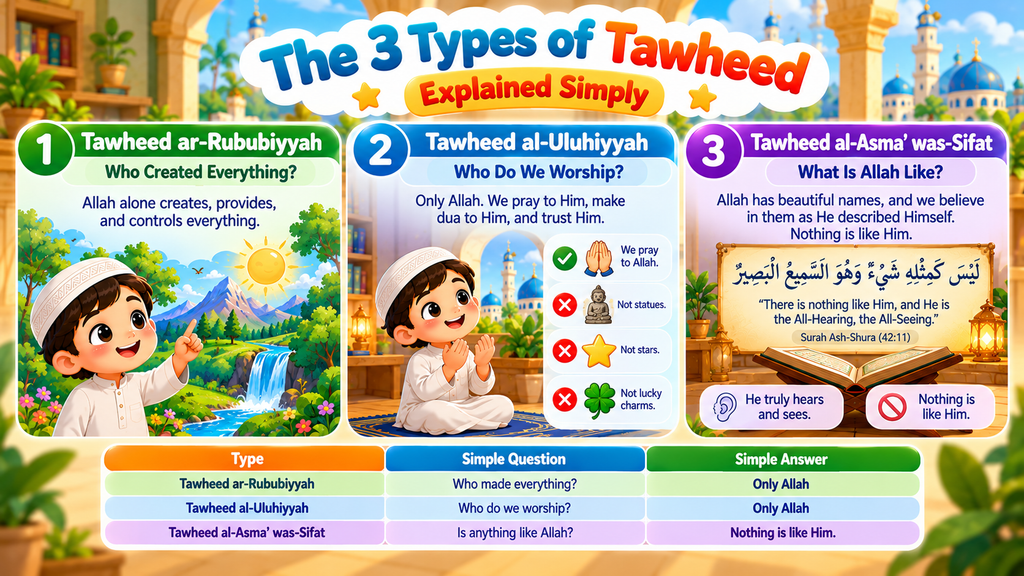
1. Tawheed ar-Rububiyyah: Who Created Everything?
Tawheed ar-Rububiyyah (Oneness of Lordship) means believing that Allah alone creates, provides, and controls everything. Allah created the world, sends rain, grows plants, and gives us life.
Parents can help children understand this concept by observing nature together. Ask simple questions like, “Who created the sun?” or “Who makes plants grow?” These everyday examples encourage children to recognize Allah as the Creator and Provider of all things.
2. Tawheed al-Uluhiyyah: Who Do We Worship?
Only Allah. We pray to Him, make dua to Him, and trust Him. We don’t pray to statues, stars, or people, and we don’t believe a lucky charm can protect us. When a child makes dua before a test, they are living this type of Tawheed.
Teach children that worship includes Salah, dua, and other acts of devotion performed for Allah alone. For example, encourage them to thank Allah for their blessings and ask Him for help when they feel worried or afraid.
3. Tawheed al-Asma’ was-Sifat: What Is Allah Like?
Allah has beautiful names, like Ar-Rahman (the Most Merciful) and As-Sami’ (the All-Hearing). We believe in them as Allah described Himself, and we know nothing is like Him.
Allah says:
لَيْسَ كَمِثْلِهِ شَيْءٌ ۖ وَهُوَ السَّمِيعُ الْبَصِيرُ
“There is nothing like Him, and He is the All-Hearing, the All-Seeing.”
In one verse, Allah teaches two things together: He truly hears and sees, and nothing is like Him. So a child can say “Allah hears me” with full confidence, without imagining ears or eyes like ours.
Parents can introduce Allah’s names gradually and explain their meanings using simple Quranic examples. For instance, when teaching As-Sami’, remind children that Allah hears their duas, even when they speak quietly. This helps them understand Allah’s attributes without comparing Him to His creation.
| Type | Simple question | Simple answer |
| Rububiyyah | Who made everything? | Only Allah |
| Uluhiyyah | Who do we worship? | Only Allah |
| Asma’ was-Sifat | Is anything like Allah? | Nothing is like Him |
What Does La Ilaha Illallah Mean? A Simple Explanation of Tawheed for Kids
The Kalimah Tawheed, La ilaha illallah, means “There is no god worthy of worship except Allah.” It is the first part of the Shahadah and expresses the most important belief in Islam: Allah alone deserves our worship.
Allah says in the Quran:
فَاعْلَمْ أَنَّهُ لَا إِلَٰهَ إِلَّا اللَّهُ
“So know that there is no god worthy of worship except Allah.”
The word “know” reminds us that saying the Kalimah is not enough without understanding its meaning. When teaching children, it helps to explain the two parts separately:
- La ilaha: No one or nothing besides Allah deserves worship.
- Illallah: Only Allah deserves our prayers, duas, and worship.
A simple way to teach Kalimah Tawheed for kids is through questions. For example, ask your child, “Do we worship the sun or the stars?” Let them answer, “No, we worship Allah alone!”
These small conversations help children understand the Kalimah naturally and connect its meaning to their everyday lives.
How Surah Al-Ikhlas Teaches Children the Oneness of Allah?
Surah Al-Ikhlas is one of the shortest chapters in the Quran, yet its four verses explain the essential meaning of Tawheed. It teaches children that Allah is One, needs no one, and is unlike anything He created.
قُلْ هُوَ اللَّهُ أَحَدٌ اللَّهُ الصَّمَدُ لَمْ يَلِدْ وَلَمْ يُولَدْ وَلَمْ يَكُن لَّهُ كُفُوًا أَحَدٌ
“Say, He is Allah, the One. Allah, the Eternal Refuge. He neither begets nor is begotten. Nor is there to Him any equivalent.”
Each verse teaches children something important about Allah:
| Verse | Simple Meaning |
| Allah is One | Allah has no partners. |
| Allah is As-Samad | Everyone needs Allah, but He needs no one. |
| He neither begets nor is begotten | Allah has no children or parents. |
| Nothing is equal to Him | Nothing in creation resembles Allah. |
The Prophet Muhammad ﷺ also taught the special value of this surah. Abu Sa’id al-Khudri narrated that a man repeatedly recited Surah Al-Ikhlas. When the Prophet ﷺ was told about it, he said:
وَالَّذِي نَفْسِي بِيَدِهِ إِنَّهَا لَتَعْدِلُ ثُلُثَ الْقُرْآنِ
“By the One in whose Hand is my soul, it is equal to one third of the Quran.”
Scholars explain that this surah holds great significance because it focuses on Allah’s Oneness and attributes.
When teaching Surah Al-Ikhlas to kids, encourage them to memorize each verse while learning its meaning. This helps children understand Tawheed rather than simply repeating the words.
What Is the Opposite of Tawheed?
The opposite of Tawheed is shirk, which means associating partners with Allah or giving others the worship that belongs to Him alone. Shirk is considered the greatest sin in Islam because it goes against the belief that only Allah deserves worship.
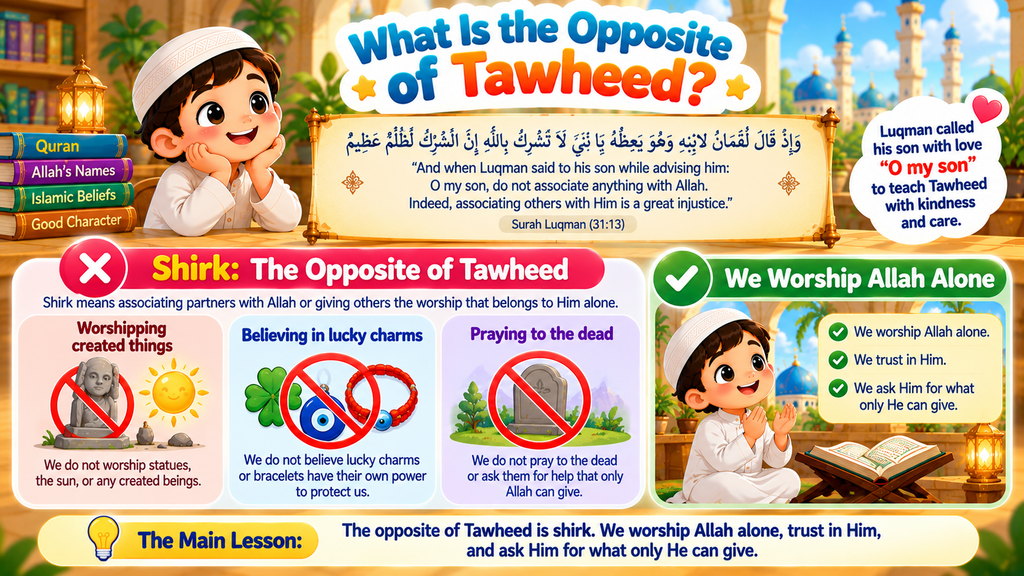
The Quran teaches this through the advice Luqman gave his son:
وَإِذْ قَالَ لُقْمَانُ لِابْنِهِ وَهُوَ يَعِظُهُ يَا بُنَيَّ لَا تُشْرِكْ بِاللَّهِ ۖ إِنَّ الشِّرْكَ لَظُلْمٌ عَظِيمٌ
“And when Luqman said to his son while advising him: O my son, do not associate anything with Allah. Indeed, associating others with Him is a great injustice.”
Luqman begins with the loving words “O my son,” showing parents the importance of teaching Tawheed with kindness and care. He explains that shirk is a great injustice because worship belongs to the Creator alone.
To help children understand shirk, use simple examples:
- Worshipping statues, the sun, or other created beings.
- Believing lucky charms or bracelets have independent power to protect us.
- Praying to the dead and asking them for help that only Allah can provide.
The main lesson is simple: We worship Allah alone, trust in Him, and ask Him for what only He can give.
Tawheed in Everyday Life: Simple Examples for Kids
Tawheed is not just a belief children learn; it is something they can practice every day. Simple words and actions help them remember Allah, recognize His blessings, and trust Him in different situations.
Here are five everyday examples of Tawheed for kids:
| Everyday Situation | What Children Can Say or Do | How It Teaches Tawheed |
| Before eating | Bismillah | Begin with Allah’s name. |
| After receiving a blessing | Alhamdulillah | Thank Allah for His blessings. |
| Making future plans | Insha’Allah | Remember that everything happens by Allah’s will. |
| Feeling scared or sad | Make dua | Turn to Allah for help and comfort. |
| Seeing something beautiful | SubhanAllah | Praise Allah for His wonderful creation. |
Learning about other Islamic beliefs also strengthens children’s understanding of Tawheed. For example, studying the angels in Islam teaches children that even these powerful creatures worship Allah alone and follow His commands.

5 Practical Tips for Teaching Tawheed to Kids at Home
Teaching Tawheed to kids doesn’t have to be complicated. Simple conversations and everyday experiences can help children understand Allah’s Oneness naturally.
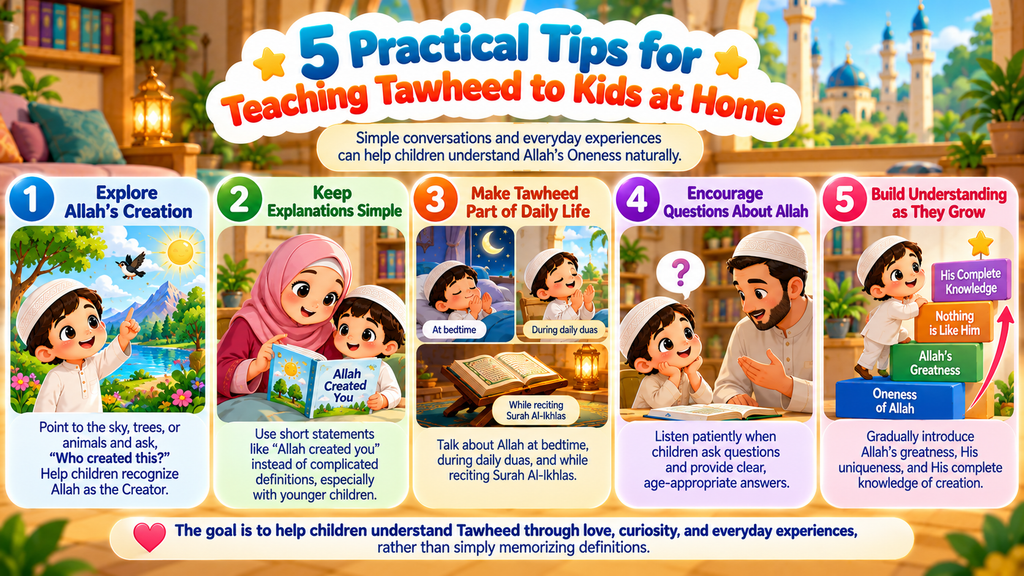
- Explore Allah’s Creation: Point to the sky, trees, or animals and ask, “Who created this?” Help children recognize Allah as the Creator.
- Keep Explanations Simple: Use short statements like “Allah created you” instead of complicated definitions, especially with younger children.
- Make Tawheed Part of Daily Life: Talk about Allah at bedtime, during daily duas, and while reciting Surah Al-Ikhlas.
- Encourage Questions About Allah: Listen patiently when children ask questions and provide clear, age-appropriate answers.
- Build Understanding as They Grow: Gradually introduce Allah’s greatness, His uniqueness, and His complete knowledge of creation.
The goal is to help children understand Tawheed through love, curiosity, and everyday experiences, rather than simply memorizing definitions.
Keep the conversation going one question at a time. For more simple lessons that build on tawheed for kids, explore our Islamic Studies section.

Help Your Child Understand Tawheed Through Islamic Education
Teaching Tawheed to kids is about more than memorizing definitions. Children need clear explanations, engaging activities, and opportunities to ask questions about Allah and Islamic beliefs. A structured learning approach can help them understand these essential concepts with confidence.
At Islamic Studies for Kids Academy, we help children understand Tawheed, Allah’s beautiful names, and essential Islamic beliefs through engaging, age-appropriate lessons based on the Quran and Sunnah. Our goal is to make Islamic learning meaningful while helping young Muslims build a strong foundation in faith.
Whether your child is learning about Allah for the first time or beginning to understand deeper Islamic concepts, the right guidance can make a lasting difference. Our approach encourages children to learn with curiosity, understand what they believe, and apply Islamic values in everyday life.
Book a Free Trial Lesson Today and help your child take the next step toward understanding Tawheed and building a strong foundation in Islam.
Our Islamic Studies Courses for Kids:
- Quran Course for Kids
- Noorani Qaida Course for Kids
- Quran Recitation Course for Kids
- Tajweed Course for Kids
- Quran Memorization (Hifz) Course for Kids
- Quran Course for Toddlers
- Quranic Arabic Course for Kids
- Quran Stories Course for Kids
Conclusion
Understanding what Tawheed is for kids is the first step toward developing a strong Islamic faith. Tawheed teaches children that Allah is One, created everything, and alone deserves our worship. Learning this belief helps them understand the purpose of worship and the importance of trusting Allah.
Parents can make Tawheed meaningful through simple conversations, Quranic stories, and everyday activities. Teaching Surah Al-Ikhlas, explaining Allah’s beautiful names, and encouraging children to make dua can help them connect Islamic beliefs with daily life.
As children grow, their understanding of Tawheed can develop through deeper questions and continued learning. With patience and guidance from the Quran and Sunnah, parents can help their children build lasting faith, recognize Allah’s blessings, and develop love for their Creator.
Frequently Asked Questions About Tawheed for Kids
1. What Is Tawheed in Simple Words for Kids?
Tawheed means believing that Allah is One. He created everything, has no partners, and is the only One worthy of worship. Nothing in creation is like Allah.
2. Why Should Children Learn Tawheed?
Tawheed is the foundation of Islamic faith. Teaching Tawheed to kids helps them understand who Allah is, why we worship Him, and how to develop a strong relationship with their Creator.
3. What Are the Three Types of Tawheed?
The three commonly taught types are Tawheed ar-Rububiyyah (Oneness of Lordship), Tawheed al-Uluhiyyah (Oneness of Worship), and Tawheed al-Asma’ was-Sifat (Oneness of Allah’s Names and Attributes).
4. How Can I Teach Tawheed to a 5-Year-Old?
Start with simple statements such as “Allah created everything” and “We worship Allah alone.” Use stories, pictures of nature, and daily duas to make learning enjoyable and easy to understand.
5. Which Surah Teaches Children About Tawheed?
Surah Al-Ikhlas is an excellent starting point. Its four verses teach that Allah is One, depends on no one, has no children or parents, and is unlike anything in creation.
6. What Is the Difference Between Tawheed and Shirk?
Tawheed means worshipping Allah alone without partners. Shirk is the opposite of Tawheed and involves associating others with Allah in worship. Children should learn this difference through gentle, age-appropriate explanations.


Leave a Reply