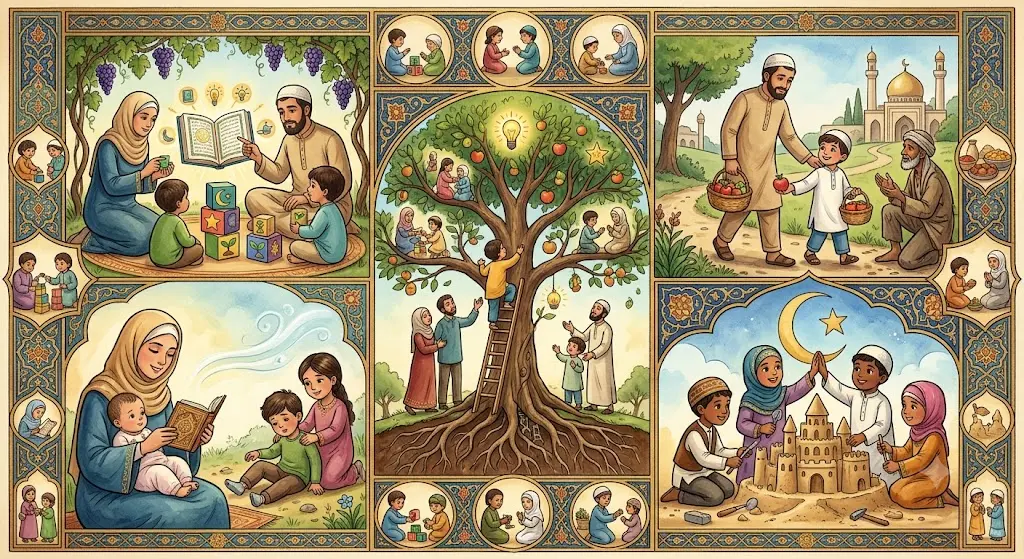
 For Parents
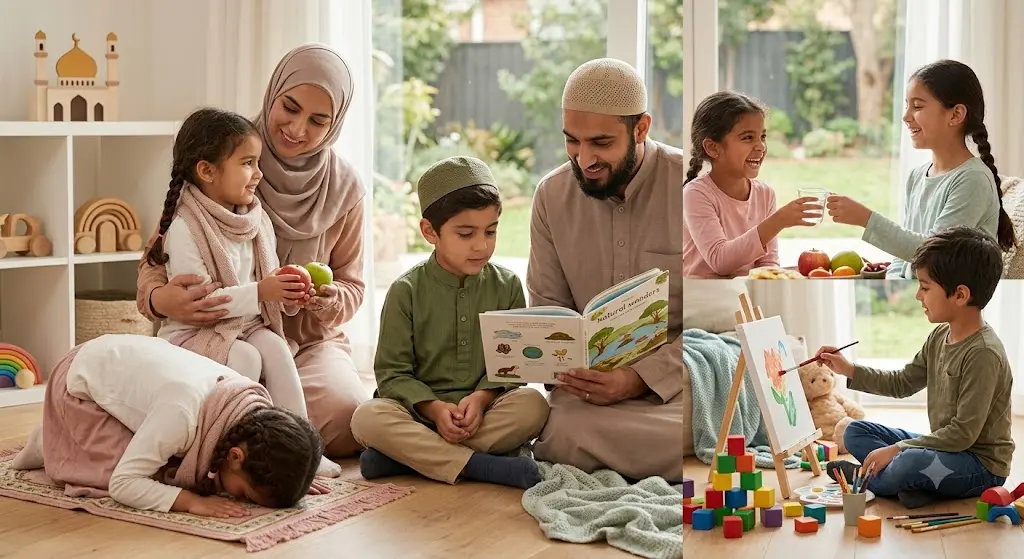
Islam established a comprehensive charter of children’s rights more than 1,400 years before the United Nations Convention on the Rights of the Child — and the scope of that charter goes far beyond what most parents realize. The rights of children in Islam are not suggestions or cultural customs; they are divine obligations anchored in the Quran and Sunnah, covering every stage of a child’s life from before conception to the end of adolescence.
If you are a Muslim parent, educator, or anyone curious about what Islam actually says about children’s welfare, this guide walks you through the full picture — what the rights are, where they come from, and what they require of you in practice.
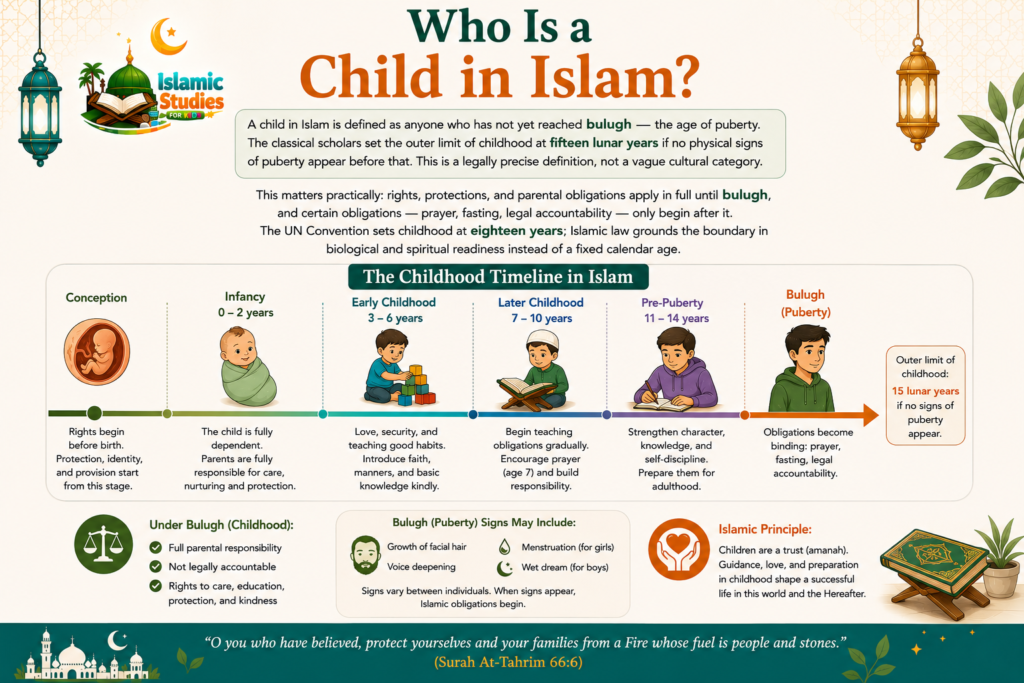
A child in Islam is defined as anyone who has not yet reached bulugh — the age of puberty. The classical scholars set the outer limit of childhood at fifteen lunar years if no physical signs of puberty appear before that. This is a legally precise definition, not a vague cultural category.
Rights of Children in Islam Before Birth
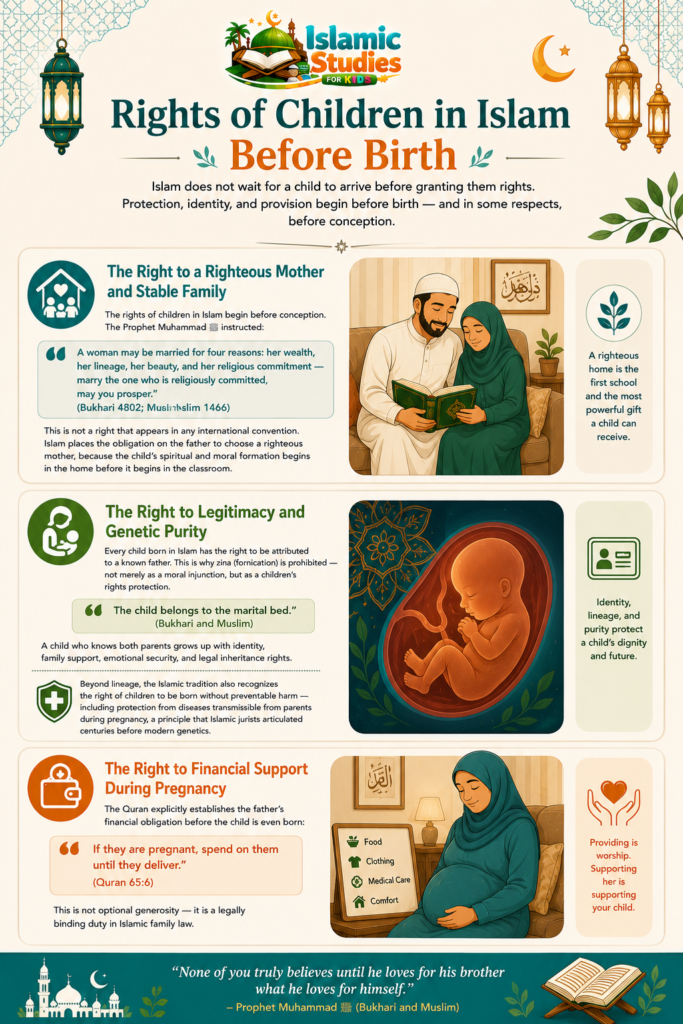
Islam does not wait for a child to arrive before granting them rights. Protection, identity, and provision begin before birth — and in some respects, before conception.
The Right to a Righteous Mother and Stable Family
The rights of children in Islam begin before conception. The Prophet Muhammad (peace be upon him) instructed: “A woman may be married for four reasons: her wealth, her lineage, her beauty, and her religious commitment — marry the one who is religiously committed, may you prosper.” (Bukhari 4802; Muslim 1466)
This is not a right that appears in any international convention. Islam places the obligation on the father to choose a righteous mother, because the child’s spiritual and moral formation begins in the home before it begins in the classroom. Scholars of the Prophetic tradition note that the child’s moral environment is shaped before birth through the character of both parents.
The Right to Legitimacy and Genetic Purity
Every child born in Islam has the right to be attributed to a known father. This is why zina (fornication) is prohibited — not merely as a moral injunction, but as a children’s rights protection. A child who knows both parents grows up with identity, family support, emotional security, and legal inheritance rights. The Prophet said: “The child belongs to the marital bed.” (Bukhari and Muslim)
Beyond lineage, the Islamic tradition also recognizes the right of children to be born without preventable harm — including protection from diseases transmissible from parents during pregnancy, a principle that Islamic jurists articulated centuries before modern genetics.
The Right to Financial Support During Pregnancy
The Quran explicitly establishes the father’s financial obligation before the child is even born: “If they are pregnant, spend on them until they deliver.” (Quran 65:6). This is not optional generosity — it is a legally binding duty in Islamic family law.
Rights of Children in Islam After Birth
The rights that activate at birth and continue through childhood are extensive. Prof. Dr. Abdel Rahim Omran, writing on children’s rights in the Quran and Sunnah, organized them into ten cardinal categories — a framework that holds up remarkably well against any modern children’s rights standard.
The Right to Life For Children
Islam prohibits killing children under any circumstance. The Quran addresses this directly, condemning the pre-Islamic practice of burying infant girls: “Kill not your children for fear of want; We provide sustenance for them and for you. Their killing is a great sin.” (Quran 17:31)
This right also extends to the unborn. Islamic jurisprudence restricts abortion — with the majority position prohibiting it after ensoulment, and some scholars prohibiting it from conception — with the sole universal exception being a direct threat to the mother’s life.
The Right to a Good Name For Children
On the seventh day after birth, it is Sunnah to give the child a beautiful name, shave the head, and perform the ‘aqiqah (sacrifice). The Prophet said: “The right of a child on his parent is to be given good breeding and a good name.” (authenticated by al-Baihaqi)
The names most beloved to Allah are ‘Abd-Allah and ‘Abd al-Rahman, according to Sahih Muslim 2132. A common parenting mistake is choosing names for their sound without considering their meaning — a child carries their name before every person they meet for their entire life.
The Right to Breastfeeding and Physical Care For Children
The Quran assigns two full years of breastfeeding as a right: “Mothers shall suckle their children two full years, for those who wish to complete the breastfeeding.” (Quran 2:233)
Modern pediatric research confirms what this verse established fourteen centuries ago — exclusive breastfeeding for the first six months and continued breastfeeding through two years significantly strengthens immunity, supports brain development, and reduces infant mortality. Islam codified this as a child’s right, not a lifestyle preference.
[image: mother and child illustrating Islamic family care]
At Islamic Studies for Kids, children learn these values in age-appropriate, engaging ways — connecting Islamic principles to real life from the very earliest age. Explore the foundational Islamic studies curriculum for toddlers and young learners at Quran for Toddlers.
The Right to Financial Maintenance For Children
Spending on one’s children is obligatory — not optional — in Islam. The Prophet said: “It is sufficient sin for a man if he neglects those on whom he is obliged to spend.” (Abu Dawud 1692; classed as hasan by al-Albani)
This maintenance covers food, clothing, shelter, healthcare, and education. If the father is unable to provide, the obligation passes to close relatives, then to the broader Muslim community through zakat and public funds. No child is meant to fall through the cracks.
Critically, the Prophet specified that all funds used in a child’s support must come from lawful sources only. Providing for a child through haram income is a sin — the child’s right is not just to be fed, but to be fed from what is halal.
Read also: How To Instill Love Of Quran In Children? ـ A Parent’s Practical Guide
The Right to Education and Training For Children
Parents are directly responsible for their children’s Islamic education — schools and mosques assist but do not replace the parental obligation. The Prophet said: “Teach the child to pray when he is seven years old, and discipline him if he does not pray when he is ten.” (Abu Dawud 494; classed as sahih by al-Albani)
The Islamic tradition goes further than most modern systems: the Prophet also instructed parents to teach children swimming, archery, and physical self-defense alongside reading and writing — a holistic integration of spiritual, intellectual, and physical development that modern pedagogy is only now rediscovering.
Muslim scholars in the 4th Hijri century — while Europe was still in the Dark Ages — called for compulsory education as a right. The Prophet himself, after the Battle of Badr, accepted the teaching of ten Muslim children to read and write as the ransom of captured prisoners, treating literacy as a national priority.
Experience a Real Classroom
Curious about how we teach? This video offers a glimpse into a real class, showcasing our interactive approach, qualified teachers, and child-friendly learning experience.
Fun & Engaging Islamic Classes for Kids
Start your child’s journey today with interactive lessons designed to make learning Islam loved and easy.
Get Your Child a Free TrialThe Right to Equitable Treatment Regardless of Gender For Children
Islam explicitly prohibits preferring sons over daughters in treatment, gifts, or affection. Anas ibn Malik reported that the Prophet saw a man who kissed his son and seated him in his lap, but when his daughter came, he sat her beside him rather than in his lap. The Prophet said: “Should you not have treated them equally?” (authenticated by al-Bazzar)
The pre-Islamic custom of burying infant girls was outlawed absolutely. The Quran frames the accountability for this act in devastating terms (Quran 81:8-9). Islam’s condemnation of gender-based discrimination in the family predates any modern gender equality framework by over a millennium.
The Right to Separate Sleeping Arrangements For Children
This right is one of the least-known among Muslim parents. The Prophet said: “Instruct your children in prayer at age seven, discipline them for it at age ten, and let them sleep separately from one another.” (authenticated by Ahmad ibn Hanbal)
This instruction serves both moral protection and the development of personal responsibility. Children who develop independent sleeping habits build self-reliance — and the instruction to separate beds at age ten aligns precisely with the onset of pre-adolescent development, offering prophylactic protection for children’s modesty and safety.
The Right to Emotional Care and Play For Children
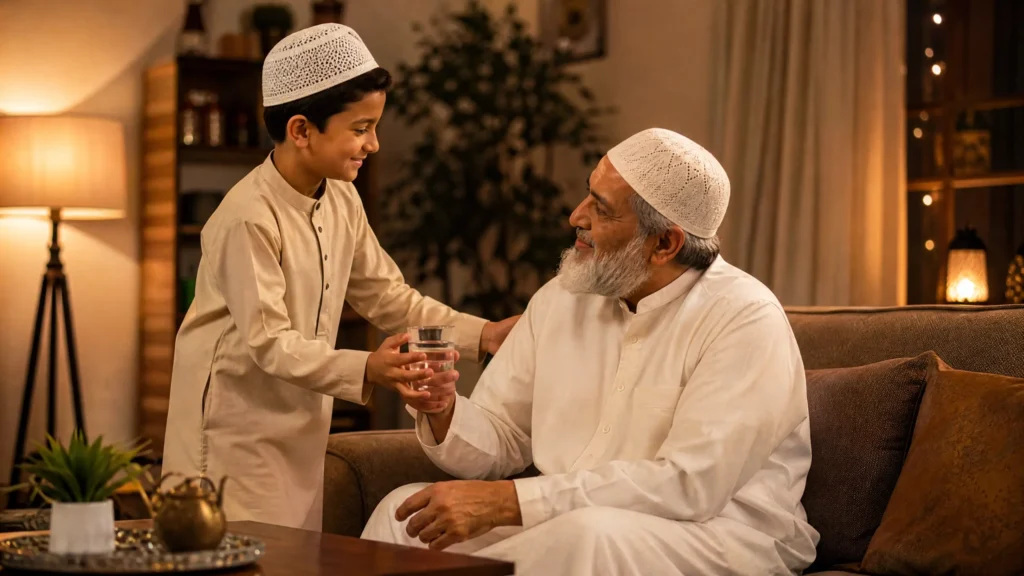
The Sunnah is filled with examples of the Prophet playing with children, carrying them during prayer, tickling them, and making them laugh. He shortened prayers when he heard an infant crying. He greeted children with salaam. He allowed children into adult gatherings.
These are not incidental kindnesses — they are the Prophet modeling that emotional warmth, play, and inclusion are part of a child’s rights. Scholars of Islamic child development note that the Prophet’s behavior with children reflects a deliberate pedagogical approach: children learn dignity when they are treated with dignity.
The Right to Religious Upbringing and Good Character For Children
The Quran records Luqman’s advice to his son as the model of Islamic parenting: begin with tawheed (the oneness of Allah), then prayer, then commanding good and forbidding evil, then patience in hardship (Quran 31:13-17). That sequence is intentional — belief grounds behavior.
The Prophet said: “There is nothing better for a parent to leave for his child than good character.” (authenticated by al-Tabarani). Material inheritance passes; character formed in childhood lasts a lifetime.
The Right to Future Security For Children
The Prophet said: “To leave your heirs rich is better than leaving them dependent upon people’s charity.” (Bukhari). This establishes financial planning and securing an inheritance for one’s children as an act of worship — not worldly attachment.
[image: Islamic family learning together]
Is your child receiving the Islamic education they deserve? At Islamic Studies for Kids, we make Islamic learning accessible, engaging, and appropriate for every age — from toddlers learning their first du’as to older children exploring Quranic tafseer and Islamic history. Browse our full range of resources at Islam Basics for Kids.
How Islamic Children’s Rights Compare to the UN Convention?
The UN Convention on the Rights of the Child (UNCRC, 1989) is widely considered the global standard for children’s welfare. Islam established a comparable — and in several respects more comprehensive — framework over 1,400 years earlier.
| Right | UNCRC (1989) | Islamic Law |
| Right to life | ✓ | ✓ (extends to the unborn) |
| Right to a name and identity | ✓ | ✓ (with guidance on names) |
| Right to parental care | ✓ | ✓ (with specific obligations) |
| Right to education | ✓ | ✓ (including physical training) |
| Right to play | ✓ | ✓ (explicitly modeled by the Prophet) |
| Right to legitimate parentage | Limited | ✓ (central to Islamic family law) |
| Right to support from lawful sources | ✗ | ✓ |
| Right to pre-birth protection | ✗ | ✓ |
| Separate sleeping arrangements | ✗ | ✓ |
One practical difference stands out: the UNCRC requires significant government expenditure to implement. The Islamic framework, as scholars have noted, distributes responsibility across the father, extended family, and community — making it implementable at every level of economic development without dependency on state budgets.
Watch a Sample Lesson from Our Academy
Get a firsthand look at how our students learn Islamic values, Quran, and essential knowledge through engaging and interactive online classes. See why families trust Islamic Studies for Kids Academy.
Read also: Duties of Parents Towards Their Children in Islam
Start Teaching Your Child Islamic Values Today
Help your child discover the beauty of Islam — from the rights Allah gave them to the duties that make a life well-lived.
Islamic Studies for Kids offers structured, engaging, and Islamically authentic learning materials designed for children at every stage, from toddlers to pre-teens. Whether you want to teach the basics of faith, introduce Quranic stories, or help your child build a daily worship habit, the resources are ready for you.

Our Islamic Studies Courses for Kids:
- Quran for Kids
- Noorani Qaida for Kids
- Quran Recitation for Kids
- Tajweed for Kids
- Quran Memorization (Hifz) for Kids
- Quran for Toddlers
- Quranic Arabic for Kids
- Quran Stories for Kids
Fun & Engaging Islamic Classes for Kids
Start your child’s journey today with interactive lessons designed to make learning Islam loved and easy.
Get Your Child a Free TrialConclusion
The rights of children in Islam form one of the most complete frameworks for child welfare ever articulated. They begin before birth — in the choice of a righteous spouse and the protection of the unborn — and extend through every stage of childhood, covering physical, financial, emotional, educational, and spiritual needs.
What makes the Islamic framework distinctive is not only its antiquity but its integration: a child’s right to be fed is paired with the right to be fed from lawful income. A child’s right to education encompasses literacy, physical training, and moral formation simultaneously. The right to equitable treatment means equal affection between sons and daughters — not just equal inheritance.
For Muslim parents, these are not historical curiosities. They are active obligations that Allah will ask about. The Prophet said: “Each of you is a shepherd and is responsible for his flock.” (Bukhari 2416; Muslim 1829). Every child in your care is your flock.
Frequently Asked Questions
What are the rights of children in Islam?
The rights of children in Islam include the right to life, legitimacy, a good name, breastfeeding, financial maintenance from lawful sources, education, physical care, equitable treatment regardless of gender, religious upbringing, emotional warmth, and future financial security. These rights begin before birth and extend through adolescence.
What are the rights of a child in Islam from the Quran?
The Quran establishes several rights directly: the right to two years of breastfeeding (2:233), the right to financial support during the mother’s pregnancy (65:6), the right to life and prohibition of infanticide (17:31), and the right to a home where parents model Islamic values (66:6). The Sunnah fills in the full detail of each right.
Who is a child in Islam?
A child in Islam is anyone who has not reached bulugh (puberty). If no physical signs of puberty appear, classical Islamic jurisprudence sets the maximum age of childhood at fifteen lunar years for both boys and girls.
Does Islam give equal rights to sons and daughters?
Yes. Islam explicitly prohibits preferring sons over daughters in affection, gifts, attention, or material support. The Prophet corrected a companion on the spot for showing more affection to his son than his daughter. Equal treatment of all children is a Prophetic obligation.
What is the right of a child to education in Islam?
Parents are obligated to teach their children the pillars of Islam, prayer, Quranic recitation, good character, and practical life skills including literacy. The Prophet also instructed that children should be taught swimming, archery, and physical training — covering spiritual, intellectual, and physical development as a unified responsibility.
Did Islam establish children’s rights before modern conventions?
Yes. Islamic law codified children’s rights — including the right to life, legitimacy, education, equitable treatment, and financial maintenance — more than 1,400 years before the UN Convention on the Rights of the Child (1989). Several rights recognized in Islam, such as pre-birth protections and the right to support from lawful sources only, are not present in the UNCRC at all.


Leave a Reply