We know Allah exists because everything around us was made, and everything that is made needs a Maker. The sky, the rain, the animals and our own bodies could not make themselves, so Allah made them.
When a child asks “If we can’t see Allah, how do we know He’s there?”, they aren’t being rude. They are curious, and they are looking for their Creator, just as Allah made them to.
Below are 10 simple proofs that Allah exists, explained for kids. Each one comes from the Quran or the Sunnah, with the Arabic text, a link to the source, a short explanation, and a sentence you can say to your child. To keep building on these lessons, browse our Islamic studies for kids.
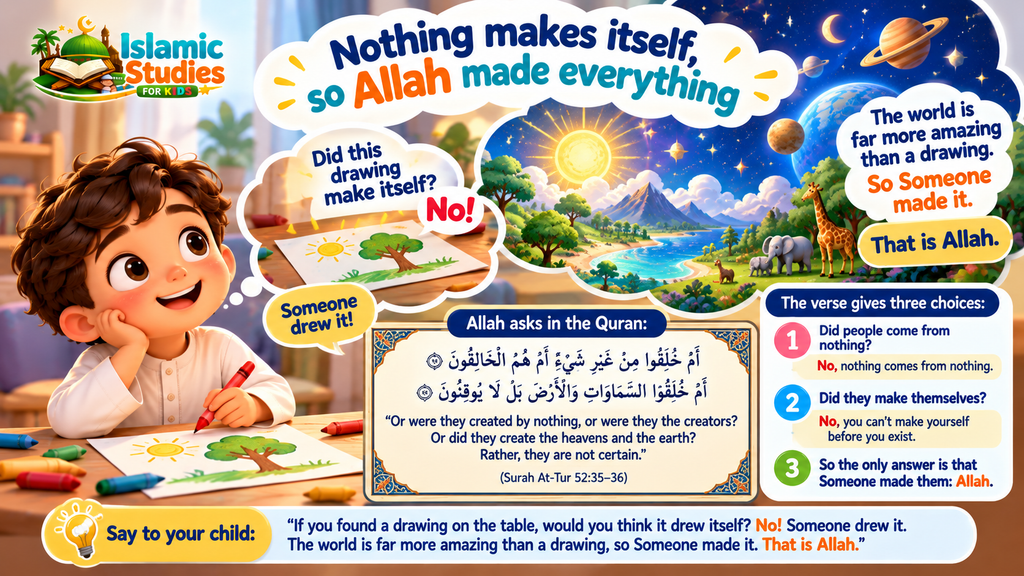
1. Nothing makes itself, so Allah made everything
This is the clearest proof Allah exists for kids. Allah asks people a simple question in Surah At-Tur:
أم خلقوا من غير شيء أم هم الخالقون أم خلقوا السماوات والأرض بل لا يوقنون
“Or were they created by nothing, or were they the creators? Or did they create the heavens and the earth? Rather, they are not certain.” (Surah At-Tur 52:35–36)
The verse gives only three choices. Did people come from nothing? No, nothing comes from nothing. Did they make themselves? No, you can’t make yourself before you exist. So the only answer left is that Someone made them: Allah.
Say to your child: “If you found a drawing on the table, would you think it drew itself? No! Someone drew it. The world is far more amazing than a drawing, so Someone made it. That is Allah.”
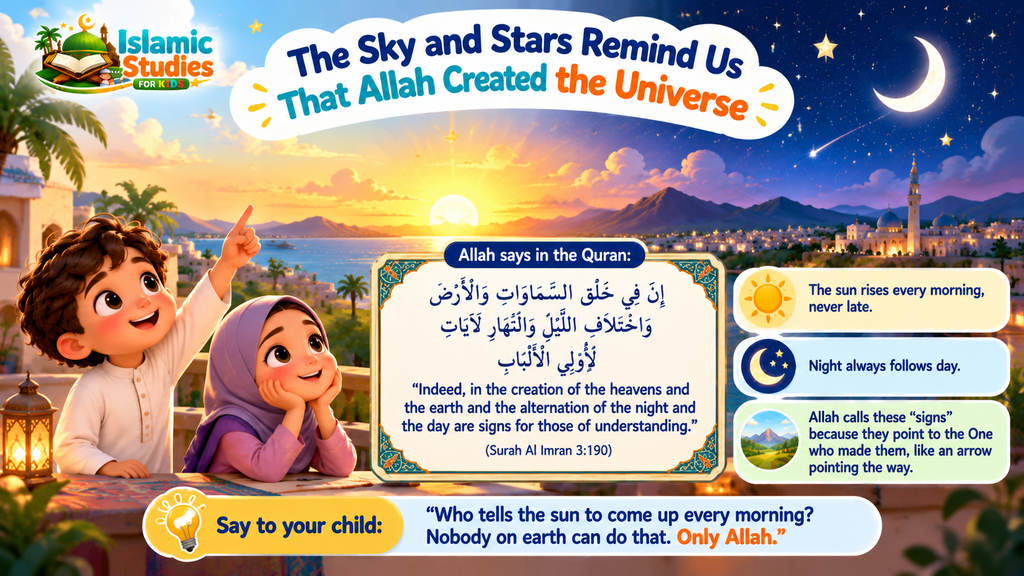
2. The Sky and Stars Remind Us That Allah Created the Universe
The signs of Allah for kids are easiest to see by simply looking up. Allah says:
إن في خلق السماوات والأرض واختلاف الليل والنهار لآيات لأولي الألباب
“Indeed, in the creation of the heavens and the earth and the alternation of the night and the day are signs for those of understanding.” (Surah Al Imran 3:190)
The sun rises every morning, never late. Night always follows day. Allah calls these “signs” because they point to the One who made them, like an arrow pointing the way.
Say to your child: “Who tells the sun to come up every morning? Nobody on earth can do that. Only Allah.”
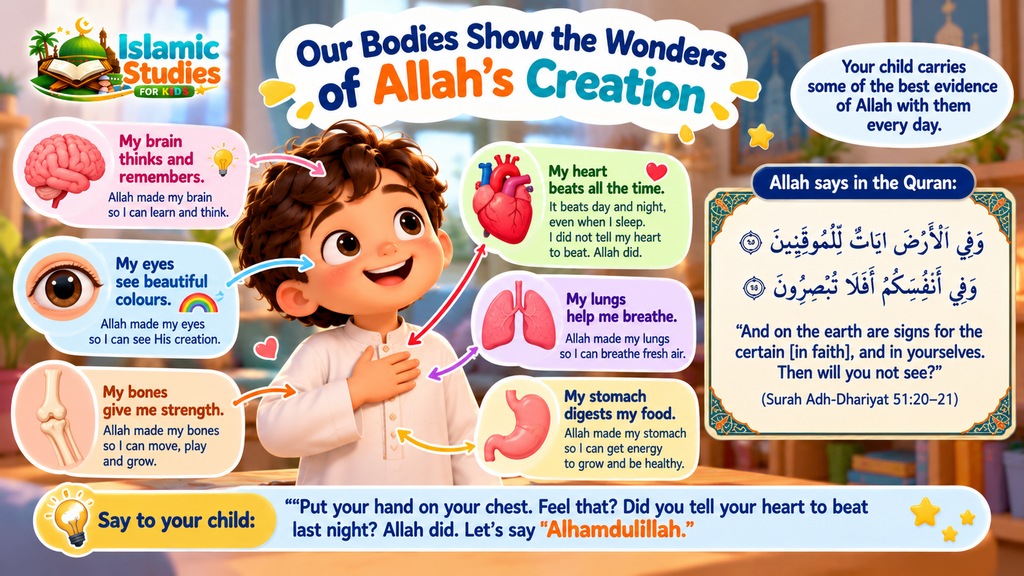
3. Our Bodies Show the Wonders of Allah’s Creation
Your child carries some of the best evidence of Allah with them every day. Allah says:
وفي الأرض آيات للموقنين وفي أنفسكم أفلا تبصرون
“And on the earth are signs for the certain [in faith], and in yourselves. Then will you not see?” (Surah Adh-Dhariyat 51:20–21)
The heart beats all night while we sleep. The eyes see thousands of colours. No one chose how their own body was built. Allah invites us to look at ourselves and notice His work.
Say to your child: “Put your hand on your chest. Feel that? Did you tell your heart to beat last night? Allah did. Let’s say Alhamdulillah.”
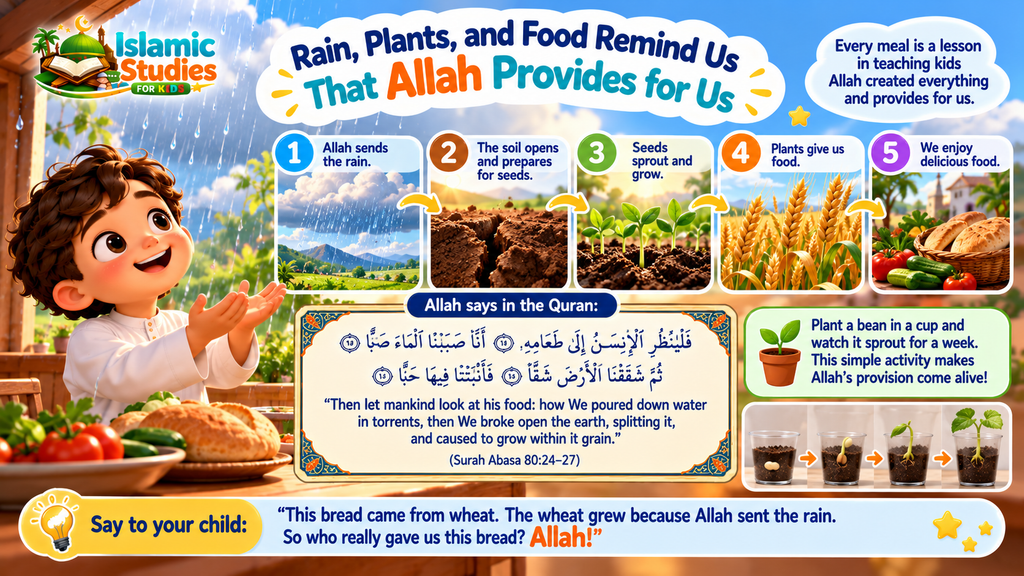
4. Rain, Plants, and Food Remind Us That Allah Provides for Us
Every meal is a lesson in teaching kids Allah created everything. Allah says:
فلينظر الإنسان إلى طعامه أنا صببنا الماء صبا ثم شققنا الأرض شقا فأنبتنا فيها حبا
“Then let mankind look at his food: how We poured down water in torrents, then We broke open the earth, splitting it, and caused to grow within it grain.” (Surah Abasa 80:24–27)
The verse walks through the steps like a story: rain falls, the soil opens, a seed sprouts, and food appears. The farmer plants the seed, but only Allah makes it grow.
Say to your child: “This bread came from wheat. The wheat grew because Allah sent the rain. So who really gave us this bread? Allah!” Planting a bean in a cup and watching it sprout for a week makes this proof come alive.
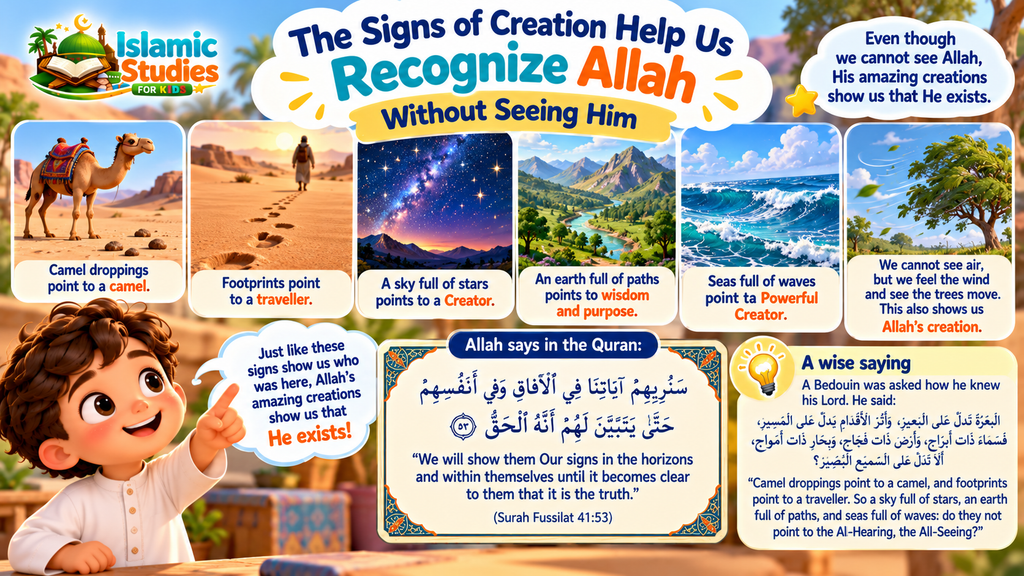
5. The Signs of Creation Help Us Recognize Allah Without Seeing Him
A famous Arabic saying, attributed to a Bedouin who was asked how he knew his Lord, teaches kids how evidence works:
البعرة تدل على البعير، وأثر الأقدام يدل على المسير، فسماء ذات أبراج، وأرض ذات فجاج، وبحار ذات أمواج، ألا تدل على السميع البصير؟
“Camel droppings point to a camel, and footprints point to a traveller. So a sky full of stars, an earth full of paths, and seas full of waves: do they not point to the All-Hearing, the All-Seeing?”
This is not a hadith, but it matches what Allah promises in the Quran:
سنريهم آياتنا في الآفاق وفي أنفسهم حتى يتبين لهم أنه الحق
“We will show them Our signs in the horizons and within themselves until it becomes clear to them that it is the truth.” (Surah Fussilat 41:53)
Kids often think “If I can’t see it, it isn’t real.” Footprints show them that we can know someone was there without seeing them. Air works the same way: we never see it, but we feel the wind and watch the trees move.
Say to your child: “When we see footprints on the beach, we know a person walked there. The stars and the seas are signs that show us Allah is there.”
A note for parents: Use footprints and air only to show that seeing isn’t the only way of knowing. Never say “Allah is like the air.” Allah says: ليس كمثله شيء “There is nothing like Him” (Surah Ash-Shura 42:11).
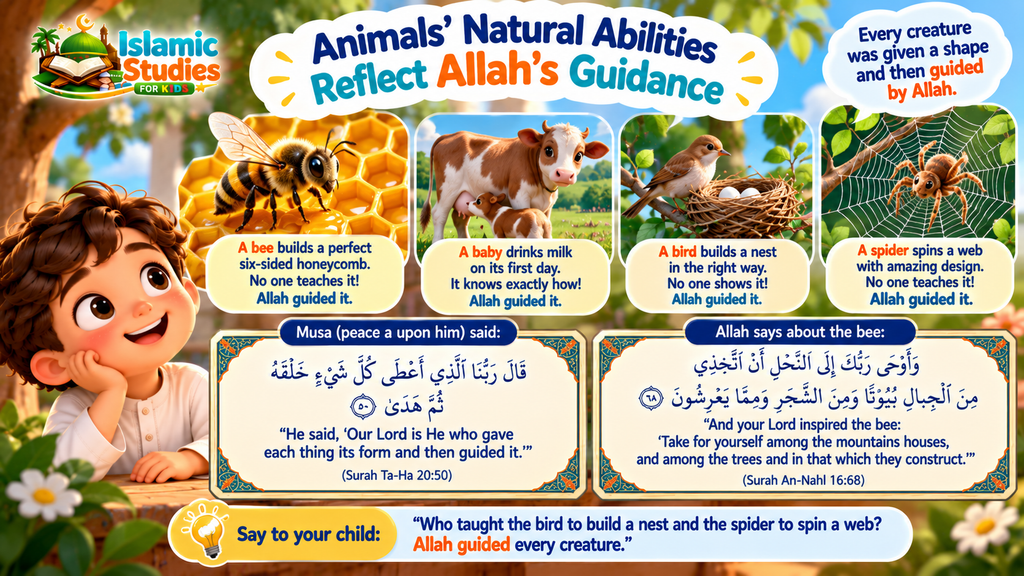
Nobody teaches a bee to build a six-sided honeycomb, or a baby to drink milk on its first day. When Pharaoh asked Musa (peace be upon him) who his Lord was, Musa answered:
قال ربنا الذي أعطى كل شيء خلقه ثم هدى
“He said, ‘Our Lord is He who gave each thing its form and then guided it.’” (Surah Ta-Ha 20:50)
Allah also tells us how He guided the bee:
وأوحى ربك إلى النحل أن اتخذي من الجبال بيوتا ومن الشجر ومما يعرشون
“And your Lord inspired the bee: ‘Take for yourself among the mountains houses, and among the trees and in that which they construct.’” (Surah An-Nahl 16:68)
Musa didn’t answer with a long argument. He pointed to something anyone can see: every creature was given a shape, then shown how to live. A bee never went to school, yet it makes honey perfectly.
Say to your child: “Who taught the bird to build a nest and the spider to spin a web? Allah guided every creature.”
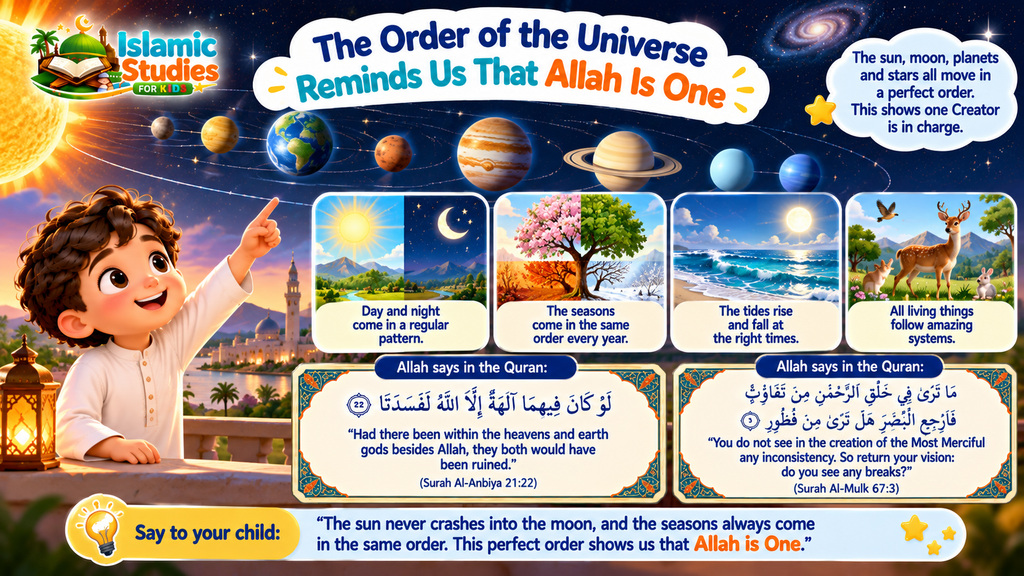
7. The Order of the Universe Reminds Us That Allah Is One
The sun never crashes into the moon, and the seasons come in the same order every year. That order shows one Creator is in charge. Allah says:
لو كان فيهما آلهة إلا الله لفسدتا
“Had there been within the heavens and earth gods besides Allah, they both would have been ruined.” (Surah Al-Anbiya 21:22)
And Allah challenges us to find even one mistake:
ما ترى في خلق الرحمن من تفاوت فارجع البصر هل ترى من فطور
“You do not see in the creation of the Most Merciful any inconsistency. So return your vision: do you see any breaks?” (Surah Al-Mulk 67:3)
This proof does two jobs. It shows that a Creator exists, and that He is One. That is the heart of tawheed, which our Aqeedah lessons for kids explain step by step.
Say to your child: “If two drivers tried to steer one car at the same time, it would crash! The world runs smoothly because only one God runs it: Allah.”
Experience a Real Classroom
Curious about how we teach? This video offers a glimpse into a real class, showcasing our interactive approach, qualified teachers, and child-friendly learning experience.
Fun & Engaging Islamic Classes for Kids
Start your child’s journey today with interactive lessons designed to make learning Islam loved and easy.
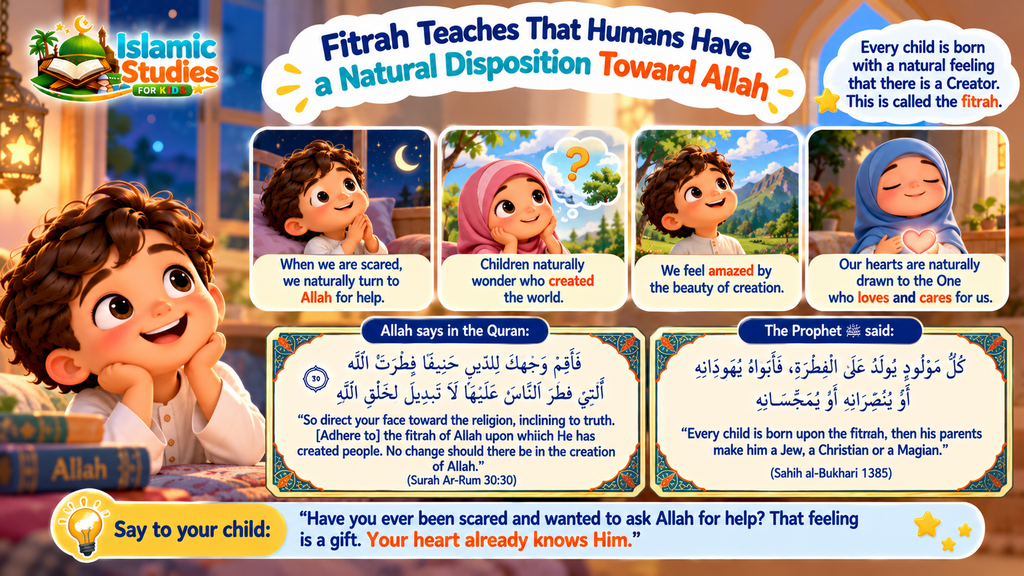
8. Fitrah Teaches That Humans Have a Natural Disposition Toward Allah
Every child is born with a natural feeling that there is a Creator. Allah calls it the fitrah:
فأقم وجهك للدين حنيفا فطرت الله التي فطر الناس عليها لا تبديل لخلق الله
“So direct your face toward the religion, inclining to truth. [Adhere to] the fitrah of Allah upon which He has created people. No change should there be in the creation of Allah.” (Surah Ar-Rum 30:30)
The Prophet ﷺ explained this in a well-known hadith narrated by Abu Hurayrah:
كل مولود يولد على الفطرة، فأبواه يهودانه أو ينصرانه أو يمجسانه
“Every child is born upon the fitrah, then his parents make him a Jew, a Christian or a Magian.” (Sahih al-Bukhari 1385)
The hadith tells us that belief in Allah is not something strange we force on children. It is already inside them. Our job as parents is to protect that feeling and help it grow, which is why the way we answer their questions matters so much.
Say to your child: “Have you ever been scared and wanted to ask Allah for help? That feeling is a gift. Your heart already knows Him.”
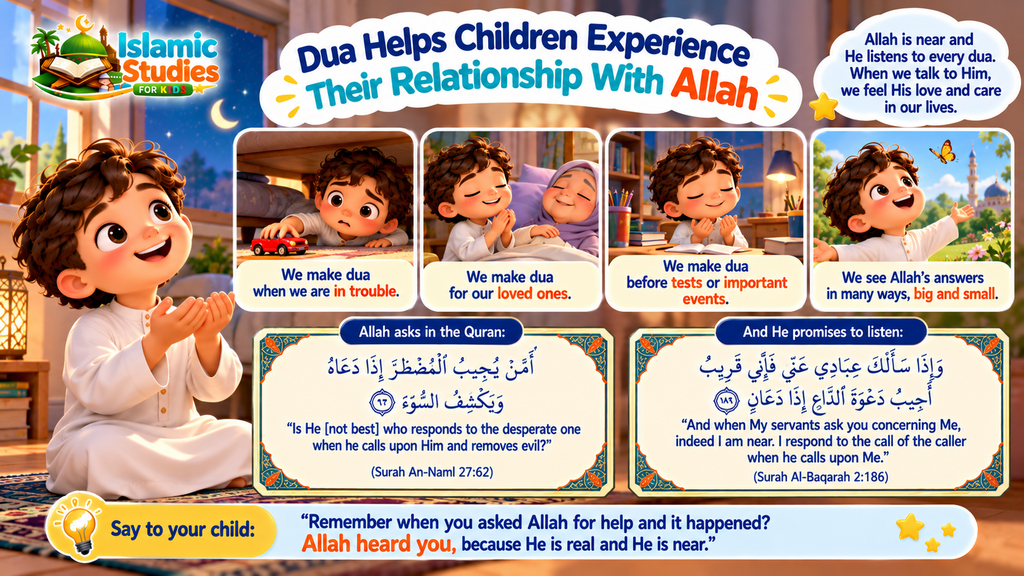
9. Dua Helps Children Experience Their Relationship With Allah
Many people, even those who say they don’t believe, call out to God when they are in trouble. Allah asks:
أمن يجيب المضطر إذا دعاه ويكشف السوء
“Is He [not best] who responds to the desperate one when he calls upon Him and removes evil?” (Surah An-Naml 27:62)
And He promises to listen:
وإذا سألك عبادي عني فإني قريب أجيب دعوة الداع إذا دعان
“And when My servants ask you concerning Me, indeed I am near. I respond to the call of the caller when he calls upon Me.” (Surah Al-Baqarah 2:186)
This proof becomes real when a child sees it in their own life. A lost toy found, a sick grandparent who got better, a test that went well after they made dua: each is a chance to say “Allah heard you.”
Say to your child: “Remember when you asked Allah for help and it happened? Allah heard you, because He is real and He is near.”
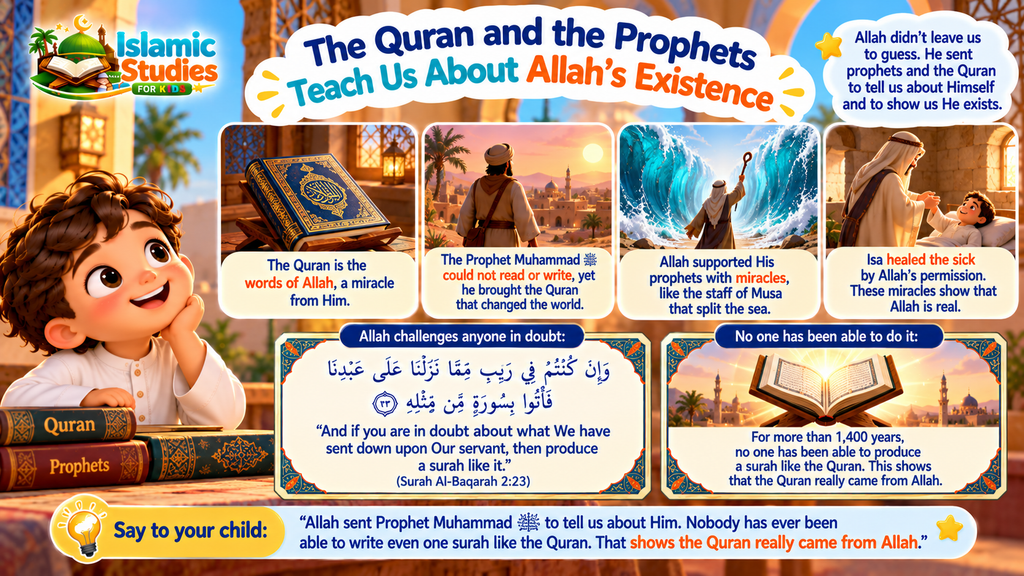
10. The Quran and the Prophets Teach Us About Allah’s Existence
Allah didn’t leave us to guess. He sent prophets and the Quran, and He challenged anyone in doubt to produce something like it:
وإن كنتم في ريب مما نزلنا على عبدنا فأتوا بسورة من مثله
“And if you are in doubt about what We have sent down upon Our servant, then produce a surah like it.” (Surah Al-Baqarah 2:23)
For more than 1,400 years, no one has met that challenge. The Prophet ﷺ could not read or write, yet he brought a book that changed the world. Allah also supported His prophets with miracles no human could do, like the staff of Musa and Isa healing the sick by Allah’s permission.
Say to your child: “Allah sent Prophet Muhammad ﷺ to tell us about Him. Nobody has ever been able to write even one surah like the Quran. That shows the Quran really came from Allah.”
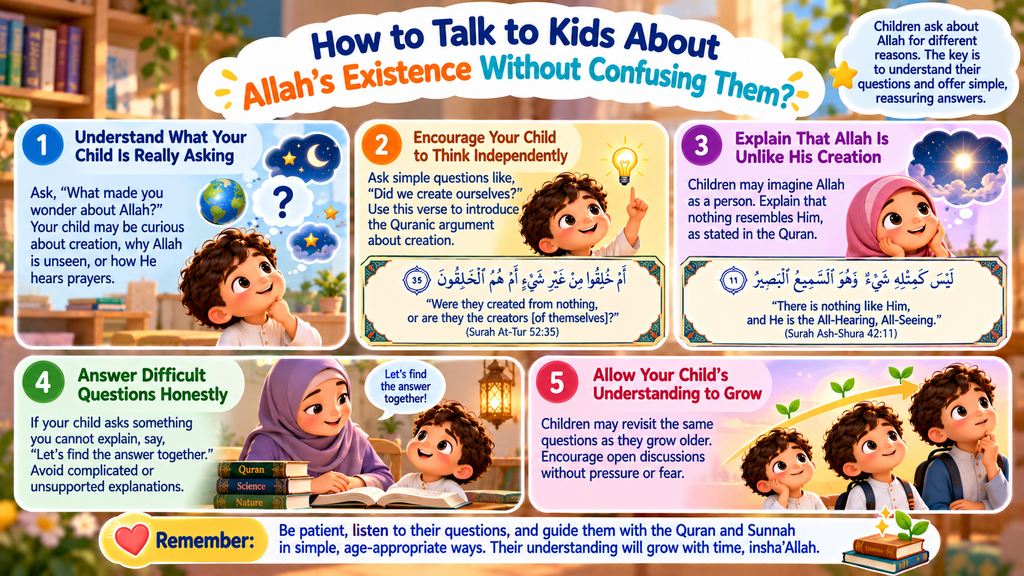
How to Talk to Kids About Allah’s Existence Without Confusing Them?
Children ask about Allah for different reasons. The key is to understand their questions and offer simple, reassuring answers.
1. Understand What Your Child Is Really Asking
Ask, “What made you wonder about Allah?” Your child may be curious about creation, why Allah is unseen, or how He hears prayers.
Listen carefully and let your child explain their thoughts without interruption. Understanding the reason behind the question helps parents give simple, age-appropriate answers that address the child’s curiosity.
2. Encourage Your Child to Think Independently
Ask simple questions like, “Did we create ourselves?” Use At-Tur 52:35 to introduce the Quranic argument about creation.
Encourage children to observe the natural world, including plants, animals, and the sky. These everyday examples can help them reflect on Allah’s creation and develop a deeper understanding of their faith.
3. Explain That Allah Is Unlike His Creation
Children may imagine Allah as a person. Explain that nothing resembles Him, as stated in Ash-Shura 42:11.
Use simple language to explain that Allah is not like humans, animals, or anything children can imagine. Remind them that Muslims believe Allah has unique attributes that cannot be compared to those of His creation.
4. Answer Difficult Questions Honestly
If your child asks something you cannot explain, say, “Let’s find the answer together.” Avoid complicated or unsupported explanations.
Parents can consult the Quran, authentic Hadith, or trusted Islamic educational resources to find reliable answers. Showing children that it is acceptable to seek knowledge encourages curiosity and thoughtful learning.
5. Allow Your Child’s Understanding to Grow
Children may revisit the same questions as they grow older. Encourage open discussions without pressure or fear.
As children develop, their questions about Allah may become more detailed. Respond with patience and adapt your explanations to their age and understanding, helping them build confidence in asking questions about Islam.
How to Explain Allah’s Existence to Kids of Different Ages
Children understand Allah’s existence differently as they grow. Use age-appropriate explanations to make learning easier.
Ages 3–5: Introduce Allah as the Creator. Use short, reassuring statements such as “Allah created the world and everything in it.”
Ages 6–8: Encourage Questions About Allah. Let children express their curiosity and explain that Allah is unlike anything He created.
Ages 9–12: Develop Understanding Through Simple Reasoning. Discuss creation, Allah’s eternal existence, and basic Quranic evidence.
Ages 13+: Explore Deeper Questions About Faith. Introduce Tawheed, Quranic arguments, and thoughtful discussions about science and belief.
Children learn best when explanations match their understanding. Our Islamic basics for kids lesson help students explore Islamic teachings through structured, age-appropriate learning.
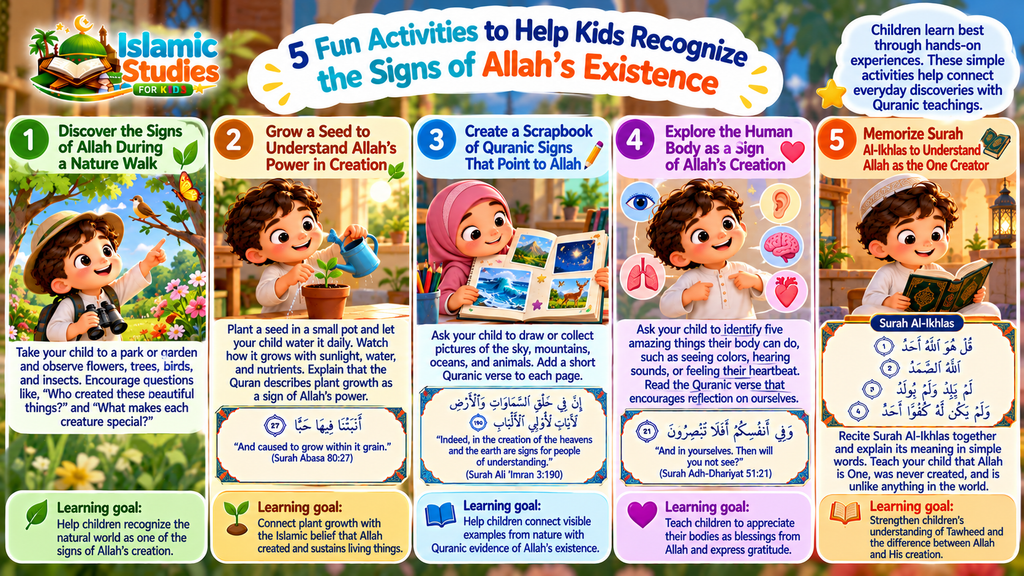
5 Fun Activities to Help Kids Recognize the Signs of Allah’s Existence
Children learn best through hands-on experiences. These five simple activities help parents connect everyday discoveries with Quranic teachings about Allah’s existence, power, and wisdom.
Discover the Signs of Allah During a Nature Walk: Take your child to a park or garden and ask them to observe flowers, trees, birds, and insects. Encourage questions like, “Who created these beautiful things?” and “What makes each creature special?”
Grow a Seed to Understand Allah’s Power in Creation: Plant a seed in a small pot and let your child water it daily. Watch how it grows with sunlight, water, and nutrients. Explain that the Quran describes plant growth as a sign of Allah’s power.
Create a Scrapbook of Quranic Signs That Point to Allah: Ask your child to draw or collect pictures of the sky, mountains, oceans, and animals. Add a short Quranic verse to each page, such as Ali ‘Imran 3:190, which encourages reflection on creation.
Explore the Human Body as a Sign of Allah’s Creation: Ask your child to identify five amazing things their body can do, such as seeing colors, hearing sounds, or feeling their heartbeat. Read Adh-Dhariyat 51:21, which encourages reflection on ourselves.
Memorize Surah Al-Ikhlas to Understand Allah as the One Creator: Recite Surah Al-Ikhlas together and explain its meaning in simple words. Teach your child that Allah is One, was never created, and is unlike anything in the world.
Watch a Sample Lesson from Our Academy
Get a firsthand look at how our students learn Islamic values, Quran, and essential knowledge through engaging and interactive online classes. See why families trust Islamic Studies for Kids Academy.
Fun & Engaging Islamic Classes for Kids
Start your child’s journey today with interactive lessons designed to make learning Islam loved and easy.
Help Your Child Discover Allah Through Islamic Studies for Kids Academy
Children naturally ask important questions such as “How do we know Allah exists?” and “Who created everything?” At Islamic Studies for Kids Academy, we help children explore these questions through Quran-based Islamic education that encourages understanding, curiosity, and a meaningful connection with Allah.
Our academy offers structured Islamic Studies and Aqeedah lessons for children ages 4 to 15, taught in English by Al-Azhar-certified tutors. Through age-appropriate explanations, guided discussions, and practical examples, students learn about Allah’s existence, His names and attributes, Tawheed, and the essential foundations of Islamic faith.
Whether your child is discovering the signs of Allah for the first time or asking deeper questions about creation and belief, our personalized lessons provide a supportive environment for learning. We aim to help children develop a stronger understanding of Islam and build lasting confidence in their faith.
Answering “How do we know Allah exists for kids?” starts with showing children the signs of Allah in the world around them. The Quran encourages us to reflect on the sky, sun, rain, plants, animals, and our own bodies as reminders of Allah’s power, wisdom, and creation.
Parents can turn these Quranic teachings into meaningful learning experiences through simple questions, nature activities, and everyday conversations. By connecting faith with familiar examples, children can begin to understand why Muslims believe Allah created everything and how His blessings touch their daily lives.
Most importantly, children should feel comfortable asking questions about Allah. Patience, clear explanations, and reliable Islamic knowledge help develop a foundation of faith built on understanding, gratitude, and love for their Creator.
Frequently Asked Questions About How We Know Allah Exists for Kids\
1. What Is the Simplest Proof Allah Exists for Kids?
The Quran encourages us to think about creation. The sky, earth, plants, animals, and our bodies are signs that Muslims understand as pointing to Allah’s power and wisdom. At-Tur 52:35 also asks us to reflect on who created us.
2. Can We Know Allah Exists Without Seeing Him?
According to Islamic belief, yes. Muslims believe in Allah through the Quran, reflection on creation, and the teachings of the prophets. Not seeing Allah does not mean He does not exist.
3. What Does the Quran Say About the Signs of Allah?
The Quran describes signs in the heavens, earth, and within ourselves. Fussilat 41:53 and Ali ‘Imran 3:190 encourage reflection on creation as a way of recognizing Allah’s greatness.
4. Why Does Allah Give Us Signs Instead of Showing Himself?
The Quran teaches that this worldly life is a test of faith and that human sight cannot encompass Allah (Al-An’am 6:103). Muslims understand the signs in creation and divine revelation as ways to know Allah without seeing Him in this life.
5. Is It Normal for Children to Question Allah’s Existence?
Yes. Children often ask questions as they develop their understanding of the world. Curiosity does not automatically mean weak faith. Parents should listen carefully, offer thoughtful answers, and encourage further learning.
6. How Can Parents Strengthen a Child’s Belief in Allah?
Teach Quranic verses, discuss the signs of creation, practice gratitude, and encourage open conversations about faith. Age-appropriate Islamic education can help children develop a deeper understanding of Allah and Tawheed.
 Islamic Studies




Leave a Reply