 Quran
Quran
Most parents want their children to grow up with strong values, sharp minds, and a sense of purpose. The Quran delivers all three — and the research and scholarly tradition behind early Quranic education show that the benefits run far deeper than most people realize.
Parents often assume Quran education begins when a child can read. But scholars and child development practitioners point to a much earlier window.
This matters because the benefits of reading the Quran for kids are not just spiritual — they are neurological, linguistic, and behavioral, and they compound over time the earlier they begin.
This article breaks down exactly what children gain when they engage with the Quran from a young age and how Islamic Studies for Kids Academy helps make that happen practically, even from home.
A. Cognitive and Academic Benefits of Quran for Children
Early Quran education does something no standard curriculum can replicate: it trains the brain through memorization, recitation, and review in a single, rhythmically structured practice.
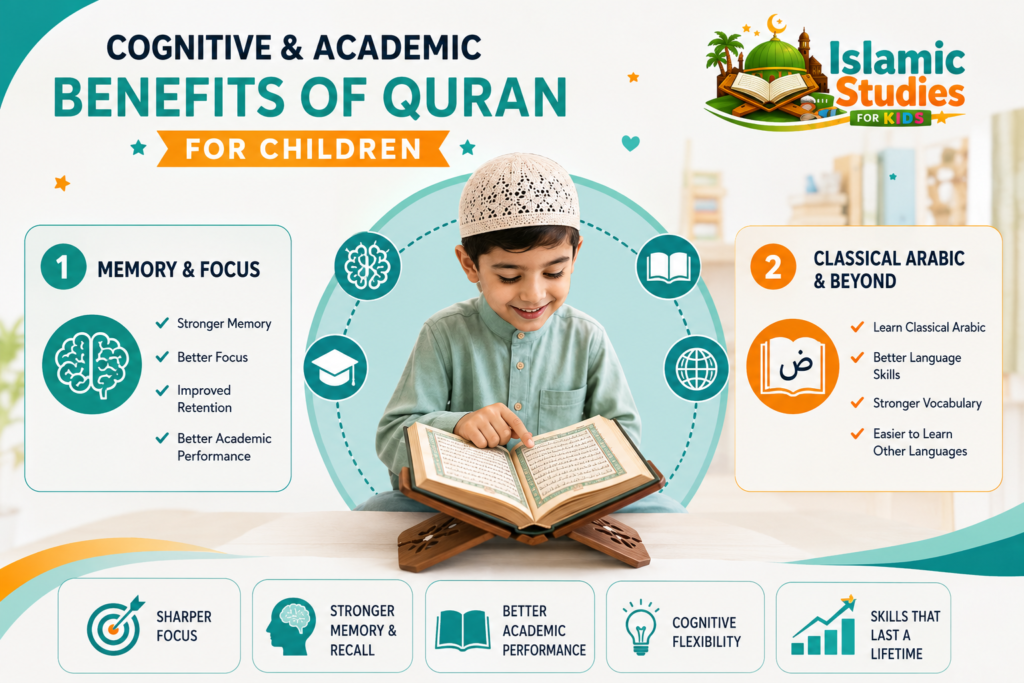
1. Quran Memorization Strengthens Memory And Focus
Hifz — the formal memorization of Quranic verses — requires a child to hold new information, connect it to what came before, and retrieve it accurately under gentle pressure. This repeated cycle of encoding and recall strengthens the same neural pathways that determine academic performance across subjects.
Children who memorize Quran regularly tend to develop longer attention spans, stronger information retention, and better performance in tasks requiring sustained concentration. The benefit is not incidental — it is a direct result of the memorization discipline itself. Parents often notice improvements in school performance within months of a child beginning structured Quran study.
2. Learn Classical Arabic And Beyond
The Quran is written in classical Arabic — one of the most structurally complex and lexically rich languages in the world. A child who reads and recites the Quran is not just learning religion; they are being immersed in a language system that sharpens grammar awareness, vocabulary depth, and precise pronunciation.
Research on bilingual and multilingual development consistently shows that early exposure to a second language — especially one with distinct phonological patterns like Arabic — builds cognitive flexibility and makes acquiring additional languages easier later. A child who begins Noorani Qaida training at five or six is building a language brain that serves them well into adulthood.
B. Moral and Character Benefits of Learning Quran for Kids
The importance of learning the Quran for kids is not limited to academic gains. The Quran’s moral framework — taught through the stories of the prophets, the ethics of daily life, and direct commands to justice and compassion — shapes character in ways that persist long after childhood.
1. Teaching Children About Right And Wrong
Children who engage with Quranic content regularly absorb lessons in humility, honesty, fairness, and care for others — not as abstract rules, but through stories with real consequences. The stories of Ibrahim, Musa, and Yusuf (peace be upon them all) present children with models of resilience under pressure, integrity when it costs something, and trust in Allah when outcomes are uncertain.
This is moral education through narrative, which is the format children’s minds are biologically designed to learn from. A child who knows the story of Musa facing Pharaoh has a framework for standing firm under pressure that no worksheet-based ethics lesson provides.
2. Building Emotional Resilience Through Recitation
The rhythmic, melodic quality of Quranic recitation has a documented calming effect on the nervous system. For children — who face stress at school, in social situations, and through developmental transitions — having a practice that reliably brings calm is genuinely valuable.
Children who recite the Quran regularly describe a sense of peace and “being heard” that other activities don’t provide. This is not metaphorical. The act of recitation is a form of focused, rhythmic breath control combined with meaning — a combination that directly reduces cortisol levels and anchors emotional state.
Read Also:Information About Quran For Kids
Experience a Real Classroom
Curious about how we teach? This video offers a glimpse into a real class, showcasing our interactive approach, qualified teachers, and child-friendly learning experience.
Fun & Engaging Islamic Classes for Kids
Start your child’s journey today with interactive lessons designed to make learning Islam loved and easy.
Get Your Child a Free TrialC. Building a relationship between the child and their Creator
The reasons to learn Quran for kids go beyond development milestones. At its core, Quran education builds a relationship — between the child and their Creator — that becomes their most reliable source of guidance through every stage of life.
1. The Quran Is The Best Foundation For A Child’s Faith
The Prophet Muhammad ﷺ said: “The best among you is the one who has learned the Quran and taught it.” (Bukhari).
This hadith does not specify age because the merit applies from the earliest moment of engagement. A child who grows up knowing verses of the Quran by heart carries a living connection to Allah that no external circumstance can take away.
Early Quran education plants the love of the faith before the world plants its competing messages. Children who know their Quran enter adolescence and adulthood with an anchor — a moral and spiritual reference point that helps them evaluate choices against something real.
If your child is ready to build this foundation, Islamic Studies for Kids Academy’s Quran Recitation Course for Kids Online is designed specifically to start them on the right foot with expert guidance from the very first lesson.
2. The Read-And-Rise Principle
The Prophet ﷺ said: “Recite and ascend in ranks as you used to recite when you were in the world. Your rank will be at the last Ayah you recite.” (Tirmidhi).
Every verse a child memorizes is a rank reserved for them in the hereafter. This is not a figure of speech — it is a specific promise about a specific outcome tied to a specific practice.
This is why the importance of Quran memorization for kids is treated as a priority in Islamic tradition, not an optional enrichment. The child who begins memorizing at eight will reach more verses than the one who begins at fifteen. Early start is compounding investment — spiritually, cognitively, and linguistically.
Read Also: Best Quran Learning Tools for Kids
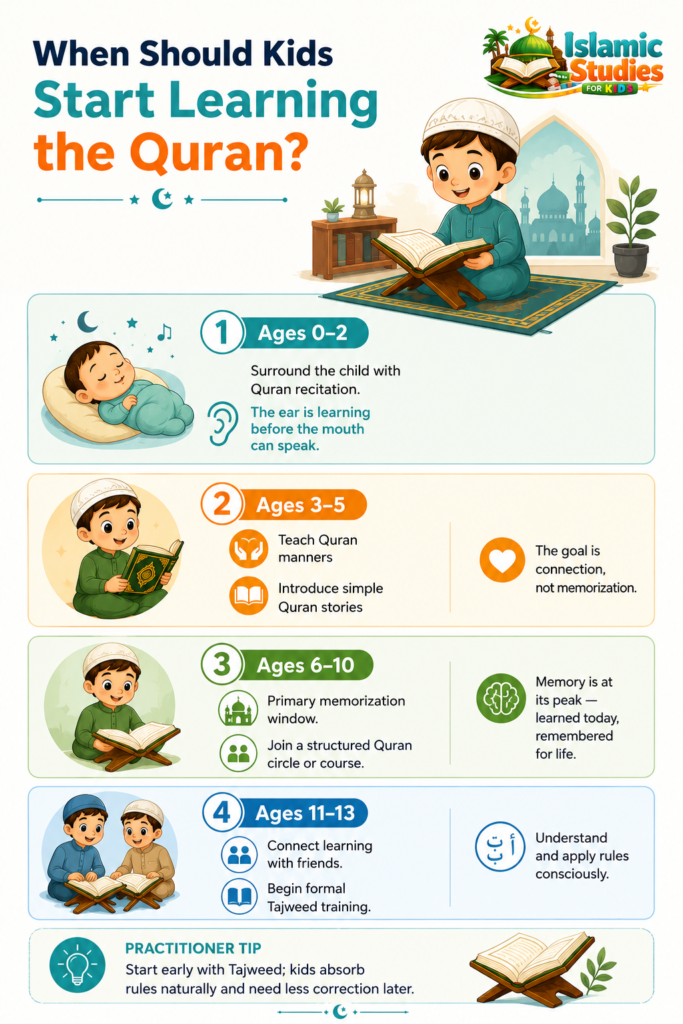
When Should Kids Start Learning the Quran?
Most families ask this question too late. The practical guidance from child development scholars in the Islamic tradition points to a clear and staged approach.
1. Ages 0–2
Surround the child with Quran recitation as ambient sound. The ear is learning before the mouth can speak.
2. Ages 3–5
Teach handling manners — how to hold the Mushaf, not to place it on the floor, to listen when it is recited.
Introduce the stories of the Quran appropriate to this age: Surah Al-Fil, the story of Abu Lahab, simple narratives with clear lessons. The goal at this stage is not memorization — it is connection.
3. Ages 6–10
This is the primary memorization window. Attach the child to a structured Quranic circle at a mosque, an Islamic school, or a qualified Quran Memorization Course for Kids Online. The child’s memory is at its peak plasticity. What is learned now settles deeply.
4. Ages 11–13
The social circle widens. The smart move here is to connect the child’s Quran learning to their friendships — enrolling them with peers, creating shared milestones.
Also the right time to begin formal Tajweed training, as the child can now understand and apply phonological rules consciously.
One practitioner observation worth noting: children who begin Tajweed before age ten tend to absorb the rules intuitively, without the effortful rule-memorization older beginners require. The earlier the ear is trained, the less correction is needed later.
Read Also: How to Learn Quran for Kids?
The Role Of Parents In Supporting Quran Learning
The most common mistake parents make is enrolling a child in Quran classes while showing no personal engagement with the Quran themselves. Children do not do what they are told — they do what they observe.
If a child sees a parent sitting with the Mushaf, listening to recitation during the commute, or completing a daily wird, Quran becomes something adults actually do not something children are forced through.
This single shift in the home environment does more for a child’s Quran motivation than any reward system.
- Recite to your children yourself: even if your own recitation needs work. The imperfect recitation of a parent carries more weight than the perfect recitation from a screen.
- Explore the Mushaf together: Go through the pages, look at the Surah names, discuss which Surah you heard in Fajr.
- When a child resists going to class, diagnose before you discipline: the class is boring, the schedule is too heavy, or the child has not connected the Quran to anything they love yet. Fix the cause, not the symptom.
Read Also: Best Quran Learning Tools For Kids
Watch a Sample Lesson from Our Academy
Get a firsthand look at how our students learn Islamic values, Quran, and essential knowledge through engaging and interactive online classes. See why families trust Islamic Studies for Kids Academy.
Fun & Engaging Islamic Classes for Kids
Start your child’s journey today with interactive lessons designed to make learning Islam loved and easy.
Get Your Child a Free TrialStart Your Child’s Quran Journey with Islamic Studies for Kids Academy
The Quran your child connects with now is the Quran they will turn to for the rest of their life. That connection does not happen by accident — it is built through the right teacher, the right pace, and a learning environment designed for how children actually learn.
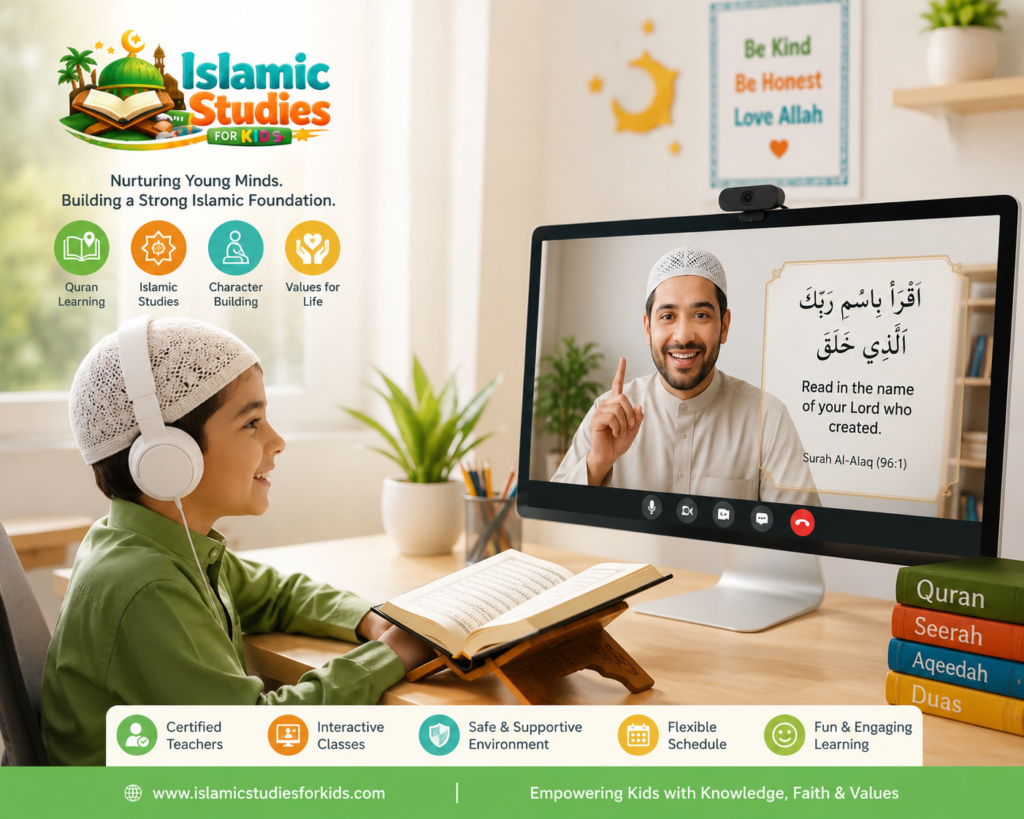
At Islamic Studies for Kids Academy, every course is built specifically for young learners — from the first letter of the Arabic alphabet all the way through full recitation and memorization. Qualified, child-focused instructors adapt to your child’s personality, age, and level so that progress feels natural, not forced.
No commute. No rigid schedules. Just expert Quran instruction your child genuinely looks forward to from home.
Enroll today and give your child the strongest start they can have with the Book of Allah.
Here is where your child can begin:
- Noorani Qaida Course for Kids Online: Learn the Arabic alphabet and basic pronunciation from scratch.
- Quran Recitation Course for Kids Online: Read full Surahs correctly with proper fluency and articulation.
- Quran Memorization Course for Kids Online: A structured Hifz path from Juz Amma and beyond.
Conclusion
The benefits of reading the Quran for kids span every dimension of a child’s development cognitive, linguistic, moral, emotional, and spiritual. Children who engage with the Quran early develop stronger memories, better character, deeper faith, and a source of calm that carries them through life’s challenges.
The importance of learning Quran for kids is not a cultural preference — it is a developmental investment with compounding returns. The earlier a child begins, the deeper those roots grow. And the parent who models love for the Quran at home is the most powerful Quran teacher their child will ever have.
Frequently Asked Questions
Parents often have practical questions before starting their child’s Quran journey — about timing, methods, online learning, and how to keep kids motivated. The answers below address the most common concerns directly, so you can move forward with confidence.
1. What are the main benefits of reading the Quran for kids?
The main benefits include stronger memory and focus through regular memorization, improved Arabic language skills, moral character development, emotional resilience from recitation, and a lifelong spiritual connection to Allah. These benefits begin accumulating from the earliest age of engagement.
2. At what age should kids start learning the Quran?
Children can begin experiencing the Quran through listening and family recitation from birth. Structured memorization is most effective from ages six to ten, when memory plasticity is at its highest. Tajweed training can begin formally from around age eight to eleven.
3. Why is Quran memorization important for kids?
Quran memorization builds neural pathways that improve focus, recall, and academic performance. Spiritually, it fulfills a prophetic tradition that promises elevated ranks in the hereafter for every verse memorized — making early memorization a compounding spiritual investment.
4. How can parents encourage kids to learn the Quran?
The most effective approach is parental modeling: children who see their parents engaged with the Quran consistently develop genuine motivation. Supplementing this with the right online program, age-appropriate stories, and peer learning environments removes the most common barriers to engagement.
5. Does learning the Quran help children academically?
Yes. The memorization and review discipline required in Quran learning directly strengthens the cognitive skills that underpin academic performance — attention, memory, and information retrieval. Many parents report measurable improvements in school focus after their children begin structured Quran study.
6. Is online Quran learning effective for young children?
Online Quran learning is highly effective when the program is designed specifically for children, includes qualified instructors, and maintains a consistent schedule. Young learners benefit from the one-on-one attention that online classes typically provide, which is often harder to achieve in large group settings.


Leave a Reply